Clan Armstrong
One of the great riding families of the Scottish Border, based in Liddesdale. The Armstrongs have had no chief since about 1610 and are counted as an armigerous clan.
History
The Armstrongs were a Border family, and their name means what it says: strong of arm. Two legends explain it. One tells of Fairbairn, an armour bearer who lifted his king to safety when the royal horse was killed in battle. The other traces the family to Siward, the Anglo-Danish Earl of Northumbria. The Armstrong Clan Association says plainly that neither has historical support. The records begin more modestly. The association finds the surname in Cumberland in 1223, and an Adam Armstrong was pardoned at Carlisle in 1235 for causing a man's death.
By about 1300 the family was settled in Liddesdale, on the Scottish side of the line, with its chief seat at Mangerton. An early laird of Mangerton, Alexander Armstrong, is said to have been murdered at Hermitage Castle by William de Soulis. From Liddesdale the name spread into Eskdale, Annandale and the Debatable Land, the strip of country that neither kingdom could control. In the sixteenth century the Armstrongs were reckoned able to muster 3,000 riders. They raided on both sides of the Border and answered to neither crown.
That power alarmed James V. In July 1530 the king came south in force and met Johnnie Armstrong of Gilnockie at Caerlanrig, south of Hawick. By most accounts Johnnie came under a promise of safe conduct. He was hanged all the same, along with his followers. The number is usually given as 36, though Gilnockie Tower's account says about 50, and the Armstrong Clan Association dates the affair to 1529. The king's household book is cited as placing James at Caerlanrig on 5 July 1530. The ballad of Johnnie Armstrong kept the grievance alive, and a memorial stands in the graveyard there.
The best story of the reiving years belongs to William Armstrong of Kinmont. In 1596 Kinmont Willie was seized on a day of truce, in breach of Border law, and held in Carlisle Castle. When the English warden refused to free him, Walter Scott of Buccleuch crossed the Eden before dawn with a raiding party and broke him out. Queen Elizabeth was furious.
The end came quickly. After the Union of the Crowns in 1603, James VI set out to pacify what had been the frontier. Around 1610 Archibald Armstrong of Mangerton, the last chief, was hanged, in Edinburgh by most accounts. The Armstrong lands passed to the Scotts, and many of the name moved to Ulster and later overseas. No chief has been traced since.
The name has not faded. An Armstrong Clan Association was founded in 1969 and the Clan Armstrong Trust in 1978. In 1972 the astronaut Neil Armstrong visited Langholm and was given the freedom of the town. Gilnockie Tower opened to visitors in 2018 and now holds the clan's collection.
Clan Armstrong tartans
Names and reference numbers follow the Scottish Register of Tartans. Mills sell most setts in modern, ancient and weathered colourways. The pattern is the same; only the shades change.
Get the kilt
When you order a kilt, ask for the tartan by its full name — for example “Armstrong” — and say which colourway you want. “Modern” is dark and strong, “ancient” is lighter, “weathered” is muted. The sett is the same in each.
We are choosing retailers we trust and will list them here soon.
Wear the colours
Our own Armstrong range is on its way: the name, the tartan and the motto on a heavyweight tee, a hoodie and a mug. About the shop.
Lands and seats
- Mangerton Tower. In Liddesdale. The seat of the Armstrong chiefs, the lairds of Mangerton.
- Gilnockie Tower. Also called Hollows Tower, near Canonbie. A sixteenth-century tower linked with Johnnie Armstrong; it now houses the Clan Armstrong Centre.
Surnames
The clan name and its spellings
- Armstrong
Names associated with Clan Armstrong
- Crozier
- Crosier
- Crozer
- Crosar
- Fairbairn
- Nixon
- Kinmont
- Crozier: Named by the Armstrong Clan Association as an associated surname. The association says the clan has no proven septs.
- Crosier: A spelling of Crozier.
- Crozer: A spelling of Crozier.
- Crosar: A spelling of Crozier.
- Fairbairn: Named by the Armstrong Clan Association as an associated surname, and tied to the clan's origin legend.
- Nixon: Named by the Armstrong Clan Association as an associated surname. The Nixons were a Border riding family in their own right.
- Kinmont: Named by the Armstrong Clan Association as an associated surname.
“Associated” means the name appears in published sept lists for this clan. It does not prove descent, and many names are linked to more than one clan. Where your family lived is often the better clue.
Questions people ask
What is the Armstrong tartan?
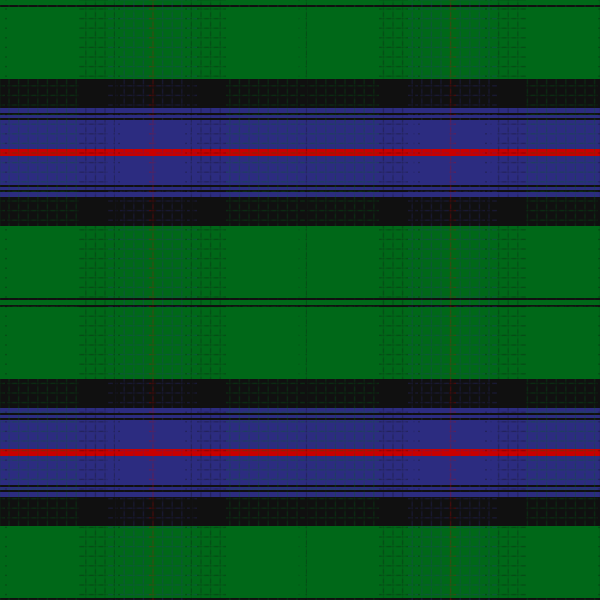
There is one Armstrong clan tartan in the Scottish Register of Tartans. It is a dark sett of green, black and blue with a fine red line, first published in the Vestiarium Scoticum of 1842.
What is the Armstrong clan motto?
The motto is 'Invictus maneo', Latin for 'I remain unvanquished'. The crest is an arm in armour, a play on the name.
Does Clan Armstrong have a chief?
No. The last chief, Archibald Armstrong of Mangerton, was executed around 1610 and no successor has been traced. The Armstrongs are therefore described as an armigerous clan. The Clan Armstrong Trust and the Armstrong Clan Association keep the name's heritage going.
Where is Clan Armstrong from?
From Liddesdale in the Scottish Borders, spreading into Eskdale, Annandale and the Debatable Land on the frontier with England. Mangerton Tower was the chief's seat, and Gilnockie Tower near Canonbie is now the clan centre.
Sources
- Clan History — Armstrong Clan Association
- Join Us and Renewals (associated surnames) — Armstrong Clan Association
- Our Story — Gilnockie Tower
- Members — The Standing Council of Scottish Chiefs
- Clan Armstrong — Electric Scotland
- Clan Armstrong — Wikipedia (supplementary check)
- Johnnie Armstrong — Wikipedia (supplementary check)
- Kinmont Willie Armstrong — Wikipedia (supplementary check)
- The Armstrong Clan (home page) — Armstrong Clan Association
- Neil Armstrong's Visit to Langholm — Historic UK
- Armstrong (ref 115) — The Scottish Register of Tartans
Clan histories are contested and sources disagree. If you can correct something here with a source, write to hello@tartanflag.com. Last updated 17 September 2026.