Clan Boyd
Clan Boyd rose from Ayrshire landholders to governors of Scotland in the fifteenth century, then fell into forfeiture twice. It is today an armigerous clan, with no chief recognised by the Lord Lyon.
History
Clan Boyd first appears in the Ayrshire district of Cunninghame in the thirteenth century. The surname's origin is disputed: it may come from the Gaelic buidhe, meaning fair or yellow-haired, or it may point back to the Isle of Bute. Tradition also links an early Boyd to Alexander III's campaign against Norse forces at Largs in 1263, though this episode is remembered more through family tradition than firm record.
The clan's documented rise begins with Sir Robert Boyd, who fought for Robert the Bruce at Bannockburn in 1314. Bruce rewarded him with lands at West Kilbride and Portencross, along with the lordship of Kilmarnock, where the family began building what became Dean Castle. His descendants held Kilmarnock as their seat for the next four centuries.
The family reached its height in the 1450s and 1460s. Robert Boyd was raised to the peerage as Lord Boyd around 1454 and later became Lord Chamberlain of Scotland. In 1466 he and his brother Alexander took charge of the boy king James III, making Robert governor of the realm. He helped arrange the king's marriage to Margaret of Denmark, a match that brought Orkney and Shetland to the Scottish crown. Overreach followed success: when Boyd's son Thomas was made Earl of Arran and married the king's sister, rivals moved against the family. In 1469 Robert was convicted of treason and fled to England, where he died soon after; Alexander was beheaded.
The Boyds recovered standing in the following two centuries. William Boyd, 10th Lord Boyd, was created Earl of Kilmarnock in 1661. That earldom ended abruptly in 1746, when William Boyd, 4th Earl of Kilmarnock, was executed for his part in the Jacobite rising, and both the earldom and the older Lord Boyd title were forfeited.
The chiefly line continued through the female descent of the Kilmarnock estates into the Hay family, Earls of Erroll. A subsidiary title, Baron Kilmarnock, was created in 1831, and in the twentieth century a holder of that barony took the surname Boyd and was accepted as chief of the name. It was for this Lord Kilmarnock that today's Boyd tartan was designed in 1956, drawing on both the Hay and Stewart lines that had come together in the family.
That chiefly line ended with the death of Alastair Boyd, 7th Baron Kilmarnock, in 2009. His successor has chosen not to seek recognition as chief, leaving Clan Boyd armigerous. The House of Boyd Society, founded in 1988, now keeps the family's history and its scattered associated names together.
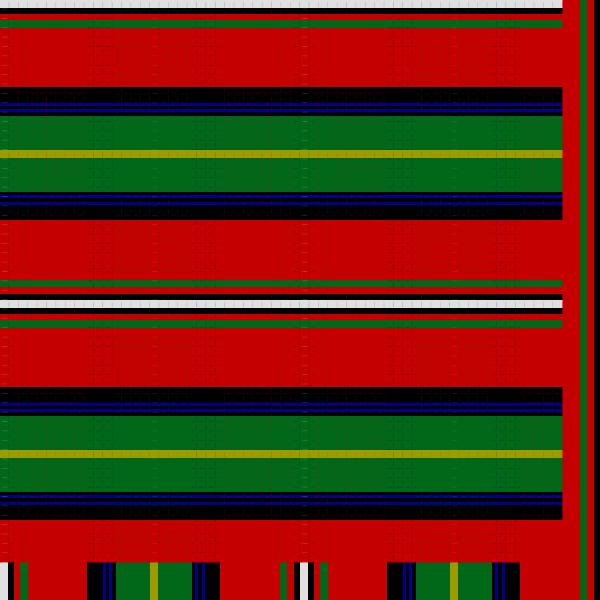
Clan Boyd tartans
Names and reference numbers follow the Scottish Register of Tartans. Mills sell most setts in modern, ancient and weathered colourways. The pattern is the same; only the shades change.
Get the kilt
When you order a kilt, ask for the tartan by its full name — for example “Boyd” — and say which colourway you want. “Modern” is dark and strong, “ancient” is lighter, “weathered” is muted. The sett is the same in each.
We are choosing retailers we trust and will list them here soon.
Wear the colours
Our own Boyd range is on its way: the name, the tartan and the motto on a heavyweight tee, a hoodie and a mug. About the shop.
Lands and seats
- Dean Castle, Kilmarnock. Built up from around 1350, it served as the Boyd family seat for more than four hundred years.
- Portencross Castle, Ayrshire. Built on coastal lands granted to the Boyds after the Wars of Independence.
Surnames
The clan name and its spellings
- Boyd
- Boyde
- Boid
- Boit
- O'Boyd
- MacGillabuidhe
Names associated with Clan Boyd
- Fullarton
- Fullerton
- Muir
- Bowie
- Brown
- Crawford
- Gemmill
- Speirs
- Fairlie
- Templeton
- Woodburn
- Fullarton: Listed among the associated families of the House of Boyd.
- Fullerton: Listed among the associated families of the House of Boyd.
- Muir: Listed among the associated families of the House of Boyd.
- Bowie: Listed among the associated families of the House of Boyd.
- Brown: Listed among the associated families of the House of Boyd.
- Crawford: Listed among the associated families of the House of Boyd; Crawford is also a clan name in its own right.
- Gemmill: Listed among the associated families of the House of Boyd.
- Speirs: Listed among the associated families of the House of Boyd.
- Fairlie: Listed among the associated families of the House of Boyd.
- Templeton: Listed among the associated families of the House of Boyd.
- Woodburn: Listed among the associated families of the House of Boyd.
“Associated” means the name appears in published sept lists for this clan. It does not prove descent, and many names are linked to more than one clan. Where your family lived is often the better clue.
Questions people ask
Is there an official Boyd tartan?
Yes. A single Boyd tartan is recorded in the Scottish Register of Tartans, designed in 1956 for the then Lord Kilmarnock. It is unrestricted, so anyone with a connection to the name can wear it.
What does the Boyd motto mean?
The motto is Confido, Latin for 'I trust'. Family tradition ties it to a gesture of confidence shown by King Alexander III to a Boyd ancestor, though this is remembered through tradition rather than contemporary record.
Does Clan Boyd have a chief?
Not currently. The last recognised chief, Alastair Boyd, 7th Baron Kilmarnock, died in 2009, and his successor has not petitioned the Lord Lyon to take up the chiefship. Clan Boyd is therefore an armigerous clan.
What surnames are associated with Clan Boyd?
The House of Boyd Society lists a long roll of associated families, including Fullarton, Muir, Bowie, Brown, Crawford, Gemmill, Speirs and Fairlie, alongside older spellings of Boyd itself such as Boyde and Boid.
Sources
- Tartan Details: Boyd (ref. 326) — Scottish Register of Tartans
- Past Chiefs of Name — House of Boyd Society, Inc.
- Septs and Surnames — House of Boyd Society, Inc.
- Our Tanist — House of Boyd Society, Inc.
- The Search for Clan Chiefs — The Standing Council of Scottish Chiefs
- Robert Boyd, 1st Lord Boyd of Kilmarnock — Encyclopaedia Britannica
- Boyd — Council of Scottish Clans & Associations (COSCA)
- Clan Boyd — Wikipedia (supplementary cross-check only)
Clan histories are contested and sources disagree. If you can correct something here with a source, write to hello@tartanflag.com. Last updated 19 September 2026.