Clan Carmichael
Carmichael is a Lowland clan from Clydesdale in Lanarkshire, long linked to the Douglases and famous for a feat of arms at the Battle of Baugé in 1421.
History
Carmichael takes its name from the family's home ground in upper Clydesdale, on the border of Lanarkshire. The name is generally read as a fusion of an old British word for a fort with the personal name Michael, pointing to a fortified place named for the saint rather than to any single founder. Local tradition also remembers a church dedicated to St Michael nearby, which may well be where the place name began.
It was as followers of the Douglases that Carmichael first enters written record: by the 1380s the family held its lands under Douglas lordship, on ground Sir James Douglas had received from Robert the Bruce in 1321 as part of a much larger grant across the district. A vassal line took the Carmichael name as its own within a couple of generations of that grant, with Sir John Carmichael usually named as its founder. Bound to Douglas fortunes from the start, Carmichael fighting men marched with the Douglas host to Otterburn in 1388, a battle the Scots won even though their commander fell in it.
It is a later generation, though, that gave the family the story it still tells. Family tradition holds that Sir John Carmichael unseated Thomas, Duke of Clarence, in a mounted clash at the 1421 Battle of Baugé, where a combined Franco-Scottish force faced the English during the Hundred Years' War, and that his lance snapped in the impact. However much of that survives intact, it is this charge that the family credits for both its crest, a mailed hand gripping a broken spear, and its motto, Tout Jour Prest, 'always ready'.
Carmichael became a barony in its own right in the following decades, and a castle is said to have gone up at the family seat around 1414. From that base, cadet branches spread across the district, giving rise to Carmichaels of Eastend, Meadowflat, Skirling, Mauldslie and Westraw. Separately, families bearing the Gaelic form of the name, rendered as MacGillemichael or MacMichael, had long been settled in Argyll and Galloway; many anglicised to Carmichael too, though their roots lie with the Stewarts of Appin rather than the Lowland barons.
The Carmichaels backed the crown during the civil wars of the seventeenth century, and it cost them: Cromwell's forces destroyed the castle in 1650, and the family withdrew to Westraw for a time. A new house, Carmichael House, rose near the old site in the following century, standing until its roof was removed in the 1950s to avoid tax duties, after which it was abandoned; the roofless shell still stands on the estate today, now a working farm and forestry business rather than a great house.
The chiefship has continued in an unbroken line to the present. The Court of the Lord Lyon confirmed Richard Carmichael of Carmichael as 30th Chief of the Name and Arms in 1981, and it was under his chiefship that the clan tartan was formally recorded in 1984, decades after a sample of the same sett had first been logged with the Highland Society in 1907. Richard Carmichael died in 2025, and leadership is understood to have passed within the family to his son as 31st of the line, according to the clan's own statements; that succession is not independently confirmed here.
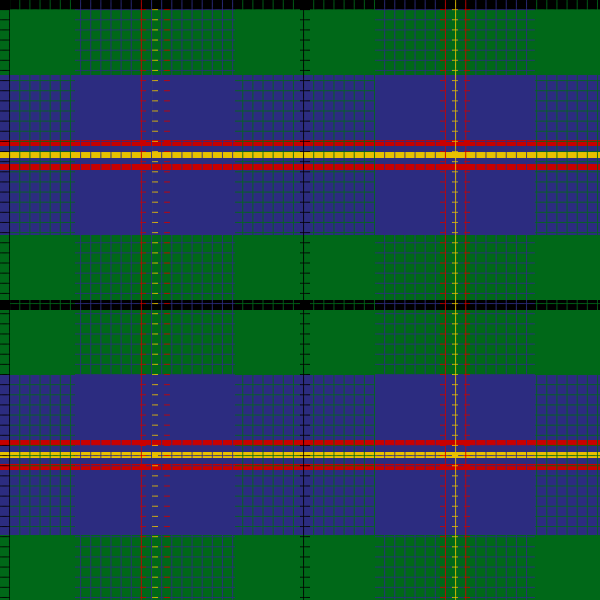
Clan Carmichael tartans
Names and reference numbers follow the Scottish Register of Tartans. Mills sell most setts in modern, ancient and weathered colourways. The pattern is the same; only the shades change.
Get the kilt
When you order a kilt, ask for the tartan by its full name — for example “Carmichael” — and say which colourway you want. “Modern” is dark and strong, “ancient” is lighter, “weathered” is muted. The sett is the same in each.
We are choosing retailers we trust and will list them here soon.
Wear the colours
Our own Carmichael range is on its way: the name, the tartan and the motto on a heavyweight tee, a hoodie and a mug. About the shop.
Lands and seats
- Carmichael Castle (site). A stronghold raised for the barons of Carmichael in the early fifteenth century, on the site now marked within the Carmichael estate; it was destroyed during Cromwell's occupation of Scotland in 1650.
- Carmichael House. An eighteenth-century mansion built near the old castle site, reputedly for the Earl of Hyndford; its roof was stripped off in the early 1950s to avoid tax liabilities, and it survives today as a roofless shell rather than having been demolished outright.
- Westraw, Pettinain. Where the family is said to have taken up residence after the destruction of Carmichael Castle in 1650.
Surnames
The clan name and its spellings
- Carmichael
- MacMichael
- McMichael
- Michael
- Michaels
- Michaelson
- Gilmichael
Names associated with Clan Carmichael
- Mitchell
- Mitchell: Sometimes traced to the same Gaelic root, Mac Gille Mhìcheil, though Mitchell is also a very common surname with independent origins and is not exclusive to the clan.
“Associated” means the name appears in published sept lists for this clan. It does not prove descent, and many names are linked to more than one clan. Where your family lived is often the better clue.
Questions people ask
What is the Carmichael tartan?
It is the single tartan recorded for the clan in the Scottish Register of Tartans, reference 565. A sample of the design was first logged in 1907, but it was not formally recorded with the Lord Lyon until 1984, under the 30th Chief.
What does the Carmichael motto mean?
The motto, Tout Jour Prest, is French for 'always ready'. Family tradition ties it to Sir John Carmichael's charge at the Battle of Baugé in 1421, which is also remembered in the broken spear on the crest.
Are Mitchell and Michael septs of Clan Carmichael?
Michael, Michaels and MacMichael are generally treated as variant spellings of the same name. Mitchell is only loosely associated, since it can derive from the same Gaelic root but is also an extremely common surname in its own right, so it should not be described as belonging to the clan.
Where does the name Carmichael come from?
It comes from a place in upper Clydesdale, Lanarkshire, and is usually explained as a fort or stronghold named for St Michael. The Carmichaels emerged there as vassals of the Douglases within a few generations of 1321, when Robert the Bruce had granted the wider district to Sir James Douglas.
Sources
- Carmichael, Scottish Register of Tartans — National Records of Scotland
- Clan Carmichael — Carmichael Estate
- Clan Chief — Clan Carmichael USA
- Badge — Clan Carmichael USA
- Carmichael House — Canmore, Historic Environment Scotland
- Carmichael — Council of Scottish Clans & Associations (COSCA)
- MacMichael / McMichael surname DNA project — FamilyTreeDNA
Clan histories are contested and sources disagree. If you can correct something here with a source, write to hello@tartanflag.com. Last updated 26 September 2026.