Clan Drummond
A Perthshire clan whose chiefly line, the Earls of Perth, rose from royal favour and a royal marriage to become one of Scotland's most influential noble houses.
History
Clan tradition traces the Drummonds to a figure named Maurice, said to have been connected to the Hungarian royal line and to have travelled to Scotland in the eleventh century in the company of Edgar Ætheling, the exiled English prince, and his sister Margaret, later Queen and saint. The story holds that Maurice was rewarded with land by the Scottish crown and that the family afterwards took its name from that estate. This account rests on genealogical tradition rather than contemporary record, and readers should treat it as clan lore rather than settled history, though it has been repeated by Drummond genealogists for centuries.
The clan's documented rise begins in the medieval period. Family tradition credits Sir Malcolm Drummond with a decisive, if unglamorous, role at Bannockburn in 1314, when he is said to have laid down caltrops, four-pointed iron spikes built to lame a charging horse, to blunt an advance by English cavalry. However embellished that story may be, Robert the Bruce granted the Drummonds land in Perthshire soon after the battle, and the caltrop endures in the family's coat of arms alongside the cautious motto the clan still bears.
The family's fortunes were transformed by marriage rather than warfare. Annabella Drummond, daughter of Sir John Drummond of Stobhall, married the future Robert III and was crowned queen in 1390. Their union lasted more than three decades, unusually long for a royal marriage of the period, and Annabella was the mother of James I of Scotland. That royal connection did more than any battle to establish the Drummonds among the first rank of Scottish noble families, and successive Lords Drummond built on it, developing Drummond Castle from the 1490s as their principal seat.
In 1605 the 4th Lord Drummond was created Earl of Perth, and the family's building and gardening at Drummond Castle continued under his successors, including the elaborate terraced gardens begun in the 1630s. The castle did not escape the upheavals of the seventeenth century: it was damaged by Cromwellian forces during the Wars of the Three Kingdoms in 1653. Worse followed in the eighteenth century, when the Drummonds' Jacobite loyalties, including prominent roles in the risings of 1715 and 1745, led to the forfeiture of the family's estates and titles by the Crown in the years after Culloden.
The Drummond name also brushed against another Highland clan. During the harsh proscription of the MacGregor name in the seventeenth century, when the Privy Council outlawed that surname outright, some MacGregor families are recorded as having taken the Drummond name to escape the ban, a reminder that clan identity was sometimes a matter of survival as much as descent. That link is specific to those name changes, not a broader sept relationship, so we have left it off the surname list below.
Despite the family's political setbacks, the gardens at Drummond Castle endured, and today they rank among Scotland's outstanding examples of formal garden design, maintained as a living part of the estate and open for visitors to explore. The clan's best-documented tartan dates from a different kind of occasion entirely: it is recorded as the sett worn by Drummonds who turned out to meet King George IV in Edinburgh in 1822, a moment that did as much as any battle to fix tartan as a badge of clan identity in the modern imagination.
Clan Drummond tartans
Names and reference numbers follow the Scottish Register of Tartans. Mills sell most setts in modern, ancient and weathered colourways. The pattern is the same; only the shades change.
 DrummondClan tartan · Register ref. 980
The Scottish Register of Tartans dates this sett to 1822, when it was worn by Drummonds attending King George IV's visit to Edinburgh. Nineteenth-century tartan writers sometimes called it the Perth Drummond, to distinguish it from a separate Strathallan Drummond sett, and the trade has long treated this one as the true Drummond pattern.
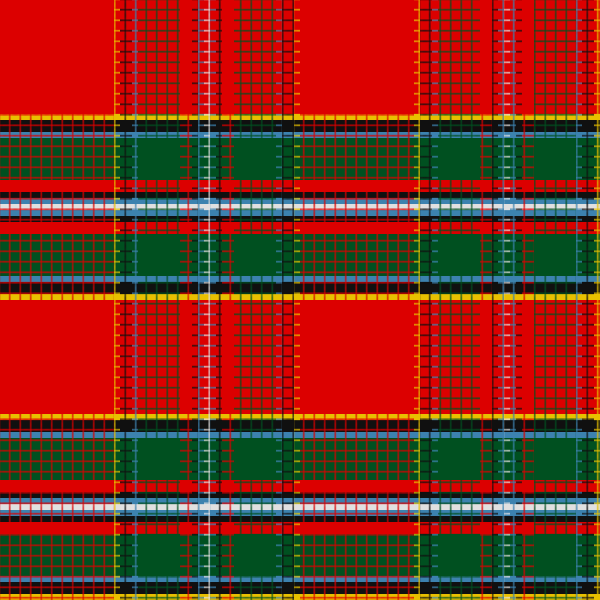 Drummond AncientOther sett · Register ref. 984
This sett comes from the MacGregor-Hastie collection, later absorbed into the Scottish Tartans Society's archive. Like many samples in that collection, it was recorded without a date or a clear source, so its age and origin are not established.
Get the kilt
When you order a kilt, ask for the tartan by its full name — for example “Drummond” — and say which colourway you want. “Modern” is dark and strong, “ancient” is lighter, “weathered” is muted. The sett is the same in each.
We are choosing retailers we trust and will list them here soon.
Wear the colours
Our own Drummond range is on its way: the name, the tartan and the motto on a heavyweight tee, a hoodie and a mug. About the shop.
Lands and seats
- Drummond Castle. Near Crieff, the clan's principal seat since a tower house was begun there around 1490; its terraced gardens, laid out from the 1630s, are a category A listed designed landscape.
- Stobhall. An earlier family seat above the River Tay near Perth, held by the Drummonds from the fourteenth century.
Surnames
The clan name and its spellings
- Drummond
Names associated with Clan Drummond
- Begg
- Brewer
- Cargill
- Doak
- Doig
- Grewar
- Gruer
- MacCrouther
- MacGrewar
- MacGrowther
- MacGruder
- Magruder
- MacGruther
- MacRobbie
- Robbie
“Associated” means the name appears in published sept lists for this clan. It does not prove descent, and many names are linked to more than one clan. Where your family lived is often the better clue.
Questions people ask
What is the Drummond tartan?
The main Drummond tartan, registered with the Scottish Register of Tartans, is dated to 1822 and is recorded as the sett worn by Drummonds who met King George IV in Edinburgh that year. A second, undated pattern known as Drummond Ancient comes from an older archival collection and has no confirmed origin.
What is the Drummond clan motto?
The motto is "Gang Warily", Scots for "go carefully". Clan tradition ties it to Sir Malcolm Drummond's use of caltrops against English cavalry at Bannockburn in 1314, a spiked device that still appears in the family's heraldry.
What surnames are associated with Clan Drummond?
Names linked to Clan Drummond include Begg, Brewer, Cargill, Doak, Doig, Grewar, Gruer, MacGruther and its variant spellings (MacCrouther, MacGrewar, MacGrowther, MacGruder, Magruder), and MacRobbie or Robbie. These are associated names rather than proven branches of the family, so treat any claimed link to your own surname as a tradition worth investigating rather than a certainty.
Where did Clan Drummond originate?
Clan tradition holds that the family descends from Maurice, a figure said to have Hungarian royal connections who arrived in Scotland in the eleventh century and was granted land by the crown. This is genealogical tradition rather than documented record. What is well established is the clan's Perthshire heartland around Strathearn, and its rise through Sir John Drummond's daughter Annabella, who became queen consort to Robert III in 1390.
Sources
- Drummond (tartan ref. 980) — Scottish Register of Tartans
- Drummond Ancient (tartan ref. 984) — Scottish Register of Tartans
- Drummond — COSCA — Council of Scottish Clans & Associations
- Drummond Castle, Formal Garden and Designed Landscape (GDL00144) — Historic Environment Scotland
- Perth, James Drummond, 4th earl of — Encyclopedia.com (Cengage)
- Annabella Drummond, Queen of Scotland — Medievalists.net
- MacGregor Clan Proscription — American Clan Gregor Society
- Perth, Earls and Dukes of — 1911 Encyclopædia Britannica (via Wikisource)
Clan histories are contested and sources disagree. If you can correct something here with a source, write to hello@tartanflag.com. Last updated 24 September 2026.