Clan Erskine
A Lowland family named for a barony on the Clyde, whose Erskine Earls of Mar guarded infant Stewart monarchs and later ruled Scotland as regents.
History
The name Erskine comes from a barony on the south bank of the Clyde, near present-day Glasgow, recorded as Erskin as early as 1225. Henry de Erskine, its proprietor under Alexander II, is on record as a charter witness in the 1220s, which makes this one of the older documented Lowland landholding families in Scotland, well before anything resembling a clan tartan or formal chiefship existed.
The family's rise turned on trust rather than territory. Sir Robert de Erskine was made custodian of Stirling Castle by David II in the fourteenth century, a post that put the Erskines at the centre of royal affairs for generations afterward. Through his son's marriage to Janet Keith, a descendant of the old Celtic earls of Mar, the family also acquired a claim to that ancient earldom, though the crown initially insisted the title itself could only pass to a royal Stewart. Sir Robert was created Lord Erskine instead, around 1467.
For much of the sixteenth century the Erskines were the family Scotland's rulers trusted with their children. Successive Lords Erskine served as guardians to the infant James V and, after him, to Mary, Queen of Scots, raising her at Stirling in the years before she went to France. John Erskine, 6th Lord Erskine, saw the earldom of Mar returned to the family in 1565 once Mary was back in Scotland; he went on to serve as Regent of Scotland and governor of both Edinburgh and Stirling castles, and was entrusted with the guardianship of her infant son, the future James VI.
The family's reach extended into the church as well as the court. John Erskine of Dun, laird of a separate Angus branch, moved in the same reforming circles as George Wishart and John Knox, played a part in bringing the teaching of Greek to Scotland, and sat repeatedly as moderator of the General Assembly of the reformed Kirk during the Reformation period. A branch of the family based at Kellie in Fife grew out of Sir Thomas Erskine, who killed Alexander Ruthven while defending James VI during the Gowrie Conspiracy of 1600, bought Kellie Castle in 1613 and was created Earl of Kellie in 1619.
Erskine fortunes were badly shaken by the Jacobite cause. John Erskine, 6th Earl of Mar, earned the nickname "Bobbing John" by switching sides so often, and it was from Kildrummy that he organised the 1715 rising before proclaiming it at nearby Braemar on 6 September 1715; the rising ended in defeat, his estates were forfeited, and he died in exile. It took decades, and the eventual joining of the Mar and Kellie titles within the same family, for the Erskines to recover their standing, and the chiefship today is still held through that combined earldom.
Later Erskines made their names away from clan affairs entirely. Thomas Erskine, from the related Erskine Earls of Buchan, built one of the great legal careers of his generation at the bar, taking up the defence of Thomas Paine and other reformers in the 1790s before a brief spell as Lord Chancellor of Great Britain in 1806–07 — a reminder that by the eighteenth century the Erskine name had spread well beyond its Clyde-side and Stirling roots.
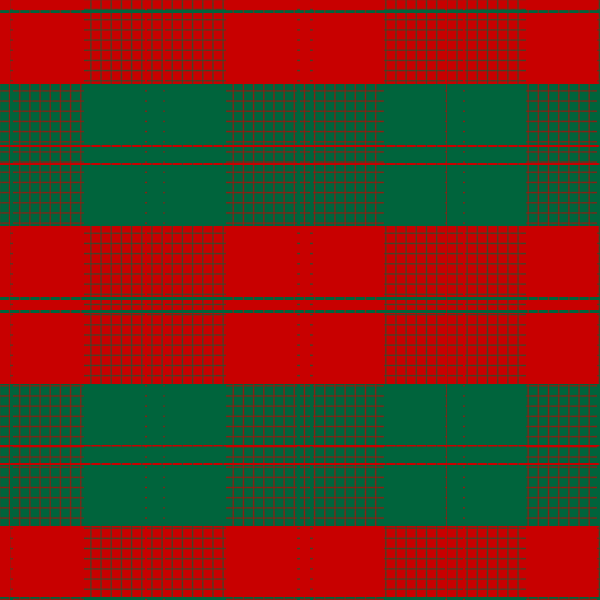
Clan Erskine tartans
Names and reference numbers follow the Scottish Register of Tartans. Mills sell most setts in modern, ancient and weathered colourways. The pattern is the same; only the shades change.
Get the kilt
When you order a kilt, ask for the tartan by its full name — for example “Erskine” — and say which colourway you want. “Modern” is dark and strong, “ancient” is lighter, “weathered” is muted. The sett is the same in each.
We are choosing retailers we trust and will list them here soon.
Wear the colours
Our own Erskine range is on its way: the name, the tartan and the motto on a heavyweight tee, a hoodie and a mug. About the shop.
Lands and seats
- Alloa Tower. Built on the Forth by the Erskine Lords Erskine and enlarged over the following centuries, it served as the family's main residence for roughly four hundred years and is now cared for by the National Trust for Scotland.
- Kellie Castle. Bought by Sir Thomas Erskine in 1613 after the Oliphant family sold it to clear debts; his descendants held it for generations before it passed, in the twentieth century, to the National Trust for Scotland.
- Kildrummy Castle. The Erskine Earls of Mar secured this Aberdeenshire stronghold in 1626. It was used as a base for the 1715 Jacobite rising and abandoned after the rising failed; it is now in the care of Historic Environment Scotland.
Surnames
The clan name and its spellings
- Erskine
- Areskine
- Arskine
- Askin
- Askine
- Erskyne
- Ireskine
Names associated with Clan Erskine
- Mar
- Miller
- Mar: Linked to Erskine through the family's long possession of the earldom of Mar, though Clan Mar today has its own separately recognised chief, so the connection is one of shared history rather than a single clan.
- Miller: Appears as an associated name in some clan-society and directory listings; the historical basis for the link is not well documented, so we note it only loosely.
“Associated” means the name appears in published sept lists for this clan. It does not prove descent, and many names are linked to more than one clan. Where your family lived is often the better clue.
Questions people ask
What is the Erskine tartan?
There is one Erskine tartan on the Scottish Register of Tartans, first published in the 1842 Vestiarium Scoticum, a work whose historical claims are treated with real caution by tartan historians. It reappeared in 1880 as "Erskine Green" in the Clans Originaux. No older Erskine tartan is recorded, so this is the clan's only sett on the register.
What does the Erskine motto mean?
The motto is Je Pense Plus, French for "I think more". It is shown beneath a crest of a hand holding a skene, a straight Scottish dagger, rising from a red cap trimmed with ermine.
Who is the chief of Clan Erskine?
The chiefship of Clan Erskine is held through the earldom of Mar and Kellie. Current clan directories name James Thorne Erskine, 14th Earl of Mar and 16th Earl of Kellie, as chief; the family's traditional seat is Alloa Tower in Clackmannanshire.
Where did Clan Erskine come from, and what surnames are linked to it?
The name comes from the barony of Erskine on the Clyde in Renfrewshire, first recorded in the 1220s. Most names linked to the clan are simply older spellings of Erskine itself, such as Areskine and Arskine; Mar is associated through the family's long hold on that earldom, though it has its own separate chief today.
Sources
- Erskine tartan (ref. 1119) — Scottish Register of Tartans
- Erskine — COSCA - Council of Scottish Clans & Associations
- Clan Erskine Society — Clan Erskine Society
- John Erskine, 1st and 18th Earl of Mar — Encyclopaedia Britannica
- John Erskine (Scottish religious leader) — Encyclopaedia Britannica
- Thomas Erskine, 1st Baron Erskine — Encyclopaedia Britannica
- Alloa Tower — National Trust for Scotland
- Kildrummy Castle: History — Historic Environment Scotland
Clan histories are contested and sources disagree. If you can correct something here with a source, write to hello@tartanflag.com. Last updated 24 September 2026.