Clan Ferguson
MacFhearghuis
A name with several separate roots across Scotland, from Ayrshire and Dumfriesshire to Perthshire, Argyll and the north-east. The chief is Fergusson of Kilkerran in Ayrshire, whose line spells the name with a double s.
History
Ferguson means 'son of Fergus', and Fergus was a common name wherever Gaelic was spoken. That is the key to the clan's history. Fergusons appear early in Ayrshire, Dumfriesshire, Argyll, Perthshire, Aberdeenshire and Fife, and tradition gives them all one ancestor. There is no evidence for that, and the families may well have begun separately, each named for a Fergus of its own.
The origin stories differ by region. The Argyll families claimed descent from Fergus Mor mac Erc, the king who is said to have brought the Scots from Ireland to Dalriada around the year 500. Those of Ayrshire and Dumfriesshire looked to Fergus, lord of Galloway, who founded Dundrennan Abbey and died at Holyrood in 1161. Both claims are traditional. The boars' heads on the Fergusson arms are often read as a nod to the Dalriadic story.
The chiefly house is Kilkerran in Carrick. The family is said to have held land there since the twelfth century, but the first certain record is of John Fergusson of Kilkerran in 1464. By about 1600 the many Fergussons of Carrick looked to Kilkerran as their head. Their neighbours were the Kennedys, and in 1601 they rode with the Earl of Cassillis in the fight near Maybole where the laird of Bargany was killed. Sir John Fergusson supported the king in the civil wars of the 1640s. A later Sir John, a prominent advocate, was made a baronet of Nova Scotia in 1703. His son Sir James became a judge in 1735 with the title Lord Kilkerran.
The Kilkerran family went on to public service overseas. The sixth baronet governed South Australia, New Zealand and Bombay in the nineteenth century. The seventh baronet was Governor-General of New Zealand from 1924 to 1930, and his youngest son Bernard Fergusson, Lord Ballantrae, held the same post from 1962 to 1967.
In the Highlands the leading family was Fergusson of Dunfallandy in Atholl, whose head was known in Gaelic as MacFhearghuis. The Atholl Fergussons followed the Murrays of Atholl. They came out for Montrose in the civil war and for the Jacobites in 1715 and 1745. Another old branch is Craigdarroch in Dumfriesshire, on record since the fourteenth century.
On spelling: the double s is the older form, a plain rendering of 'Fergus's son'. One account has it that record clerks began dropping one s before 1600. The Ayrshire, Dumfriesshire, Argyll and Perthshire families mostly kept Fergusson, while those in Fife, Aberdeenshire, Angus and Ireland settled on Ferguson. We use the single s on this page because that is how the Scottish Register of Tartans names the tartans. Both spellings share the same chief. Well-known bearers include the poet Robert Fergusson (1750-74), to whom Burns raised a memorial, Adam Ferguson (1723-1816), chaplain to the Black Watch, and Patrick Ferguson (1744-80), who designed a breech-loading rifle.
Clan Ferguson tartans
Names and reference numbers follow the Scottish Register of Tartans. Mills sell most setts in modern, ancient and weathered colourways. The pattern is the same; only the shades change.
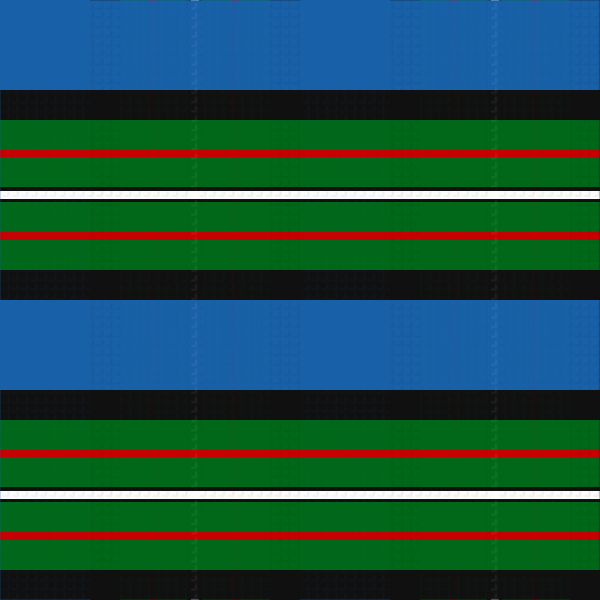 Ferguson of AthollClan tartan · Register ref. 1165
A blue, black and green sett with red and white lines. A woven sample appears in the Clans Originaux collection under the plain name 'Ferguson', and the Atholl Fergusons, like the MacLarens, were followers of the Murrays of Atholl. It is close to MacLaren, which has a yellow line where this has white.
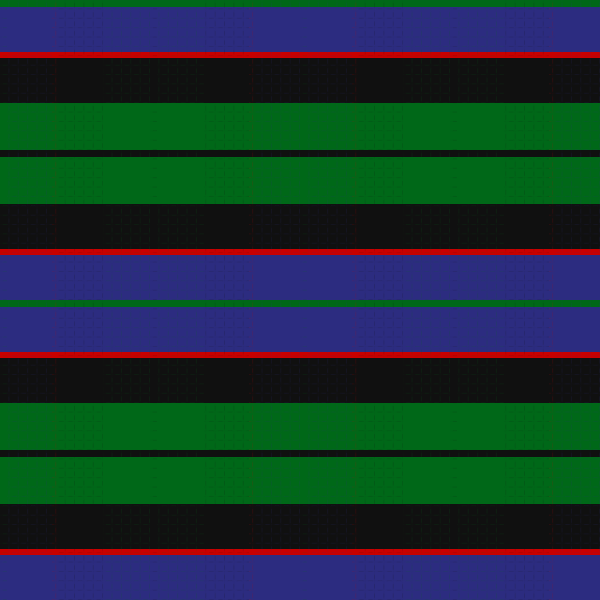 Ferguson of BalquhidderOther sett · Register ref. 1167
A darker sett of blue, black and green with a red line, based on the count James Logan published in 1831. D. C. Stewart named it Ferguson of Balquhidder to tell it apart from the Atholl sett. The Register notes that the green stripe on the broad blue is now often woven in black.
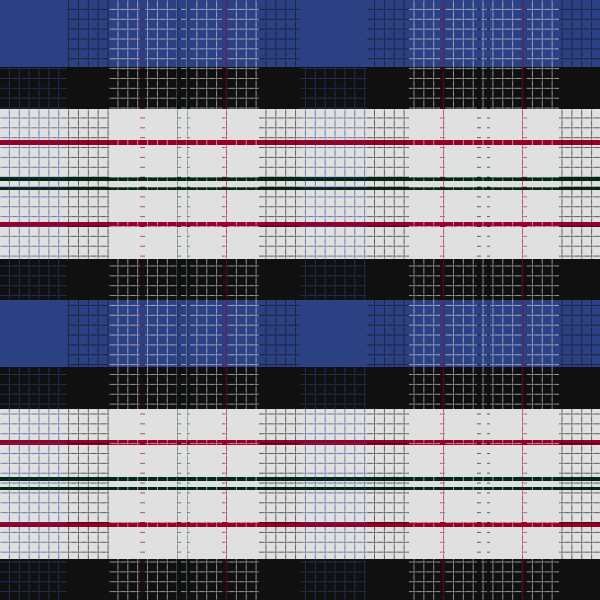 Ferguson DressDress tartan · Register ref. 1162
A dress sett with a white ground, blue and black bands and fine red and green lines. The Register records it from the Scottish Tartans Society archive without a date or designer.
Get the kilt
When you order a kilt, ask for the tartan by its full name — for example “Ferguson of Atholl” — and say which colourway you want. “Modern” is dark and strong, “ancient” is lighter, “weathered” is muted. The sett is the same in each.
We are choosing retailers we trust and will list them here soon.
Wear the colours
Our own Ferguson range is on its way: the name, the tartan and the motto on a heavyweight tee, a hoodie and a mug. About the shop.
Lands and seats
- Kilkerran House. Seat of the chiefs in Carrick, south Ayrshire.
- Dunfallandy. Near Pitlochry in Atholl; home of the principal Highland branch of the name.
Surnames
The clan name and its spellings
- Ferguson
- Fergusson
- Fergussone
- MacFergus
Names associated with Clan Ferguson
- Fergus
- Fergie
- Forgie
- Ferries
- Fergushill
- Keddie
- Kiddie
- Kidd
- Kydd
- MacKeddie
- MacAdie
- MacKerras
- MacKersey
- MacHerries
- Hardie
- Hardy
“Associated” means the name appears in published sept lists for this clan. It does not prove descent, and many names are linked to more than one clan. Where your family lived is often the better clue.
Questions people ask
What is the Ferguson tartan?
The usual Ferguson tartan is the Atholl sett: blue, black and green with thin red and white lines. A second old sett, Ferguson of Balquhidder, is darker and has no white. Neither carries any restriction in the Register.
Is it Ferguson or Fergusson?
Both are the same name. The chiefs at Kilkerran and most south-western and Perthshire families keep the double s, while the single s became usual in the north-east, Fife and Ireland.
What is the Ferguson clan motto?
The motto is 'Dulcius ex asperis', Latin for 'Sweeter after difficulties'. It goes with the crest of a bee on a thistle.
Which surnames are associated with Clan Ferguson?
Published sept lists include Fergus, Fergie, Forgie, Ferries, Keddie, Kidd, MacAdie, MacKerras and MacKersey, among others. They are associated names only: a family link is possible but should not be assumed.
Sources
- Fergusson Clan History — ScotClans
- Fergusson — Memphis Scottish Society
- Clan Fergusson — Wikipedia
- Fergusson baronets — Wikipedia
- Craigdarroch — Wikipedia
- Tartan details: Ferguson of Atholl Clan — The Scottish Register of Tartans
- Tartan details: Ferguson of Balquhidder #2 — The Scottish Register of Tartans
- Tartan details: Ferguson Dress #2 — The Scottish Register of Tartans
Clan histories are contested and sources disagree. If you can correct something here with a source, write to hello@tartanflag.com. Last updated 17 September 2026.