Clan Fraser
Friseal
The Frasers came to Scotland in the 12th century and grew into two separate clans: Clan Fraser in the north-east, led by the Saltoun line, and Clan Fraser of Lovat around Beauly.
History
The Fraser name is French in origin, though nobody has pinned down exactly where it began. Anjou is the usual suggestion. The link with the French word for strawberry, fraise, is heraldic wordplay, and it explains the strawberry flowers on the Fraser arms. The first written record in Scotland dates from about 1160, when a Simon Fraser held land at Keith in East Lothian and gave a church there to the monks of Kelso Abbey. From there the family spread into Tweeddale and later north.
The Wars of Independence made the name. Sir Simon Fraser fought for Robert the Bruce, was captured, and was executed in London in 1306. His kinsman Alexander Fraser of Cowie served as Bruce's chamberlain and married the king's sister Mary. The two main Fraser lines both trace back to this generation.
The senior line settled in Buchan. In 1375 Sir Alexander Fraser gained the castle and lands of Philorth through marriage to a daughter of the Earl of Ross. In 1592 a later Sir Alexander received charters for the fishing village of Faithlie, which grew into Fraserburgh. He was even authorised to found a university there. In 1669 another Alexander Fraser succeeded as Lord Saltoun, and the chiefs of Clan Fraser have held that title since. The present chief is the Lady Saltoun.
The other line went into the Highlands. The Lovat Frasers were settled in the Aird and around Beauly by the early 1300s and became a Gaelic Highland clan. Their chief is known as MacShimidh, son of Simon. In 1544 they fought Clanranald at the Battle of the Shirts, with heavy losses on both sides.
The best-known Lovat chief is Simon Fraser, the 11th Lord, called the Fox. He backed the government in 1715 and won a pardon. In 1745 he hedged, then sent his son out with the clan for Prince Charles. He was beheaded on Tower Hill on 9 April 1747. Castle Dounie was destroyed after Culloden and the title was forfeited. His son later raised the 78th Fraser Highlanders for the Crown. A kinsman was created Baron Lovat in 1837, and the attainder on the old title was later reversed. The Lovat Scouts were raised for the Boer War, and the 15th Lord Lovat, the 17th by the clan's own count, served as a commando officer in the Second World War.
Today the two are recognised as separate clans, each with its own chief. The Standing Council of Scottish Chiefs lists both the Lady Saltoun and the Lord Lovat. We cover them on one page because they share a name and an ancestry, but neither chief speaks for the other.
Clan Fraser tartans
Names and reference numbers follow the Scottish Register of Tartans. Mills sell most setts in modern, ancient and weathered colourways. The pattern is the same; only the shades change.
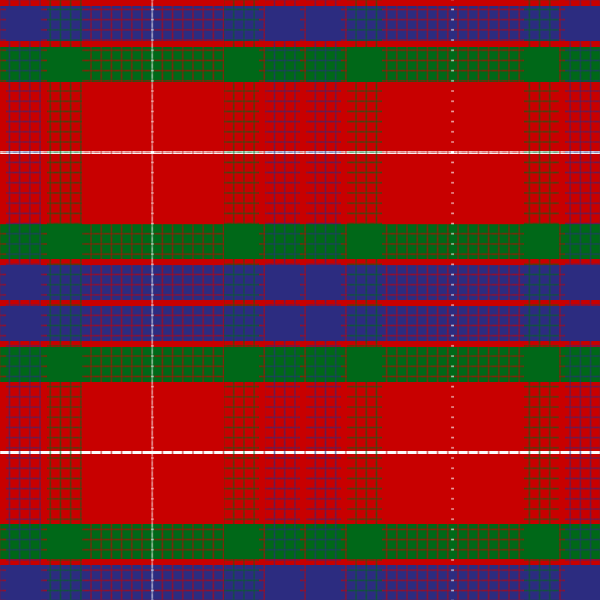 FraserClan tartan · Register ref. 1247
The red Fraser sett most people know, and the one shown for the name in the Vestiarium Scoticum of 1842. The Register quotes a letter from Lord Lovat, printed in 1850, saying old plaids proved this was the pattern worn before 1745. It also records D.W. Stewart's view that the sett began as an early Grant tartan.
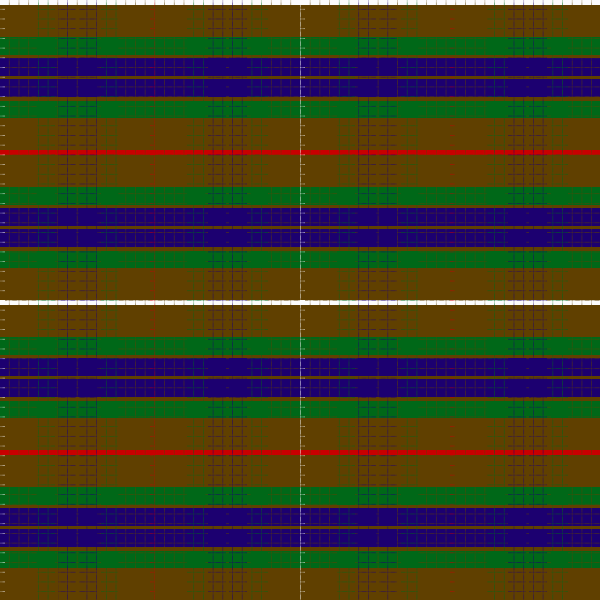 Fraser HuntingHunting tartan · Register ref. 1258
Brown takes the place of the red in the clan sett, and red replaces every second white line. According to the Register, Charles Ian Fraser of Reelig wrote that the Sobieski Stuart brothers designed it for Lord Lovat, for the Inverness and Nairn militia. D.C. Stewart thought it was more recent.
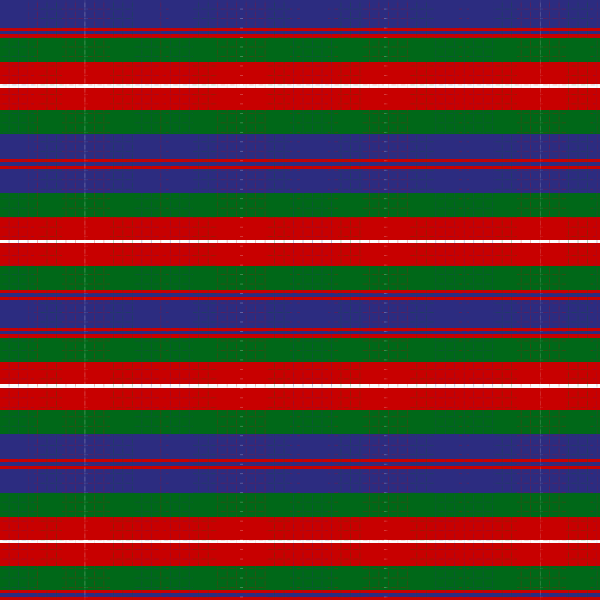 Fraser of LovatOther sett · Register ref. 1264
A red, green and blue sett with a white line, named for the Lovat line. The Register notes that it was illustrated in D.W. Stewart's 'Old & Rare Scottish Tartans' in 1893.
Get the kilt
When you order a kilt, ask for the tartan by its full name — for example “Fraser” — and say which colourway you want. “Modern” is dark and strong, “ancient” is lighter, “weathered” is muted. The sett is the same in each.
We are choosing retailers we trust and will list them here soon.
Wear the colours
Our own Fraser range is on its way: the name, the tartan and the motto on a heavyweight tee, a hoodie and a mug. About the shop.
Lands and seats
- Cairnbulg Castle (Philorth). Near Fraserburgh in Aberdeenshire. The Frasers gained Philorth by marriage in 1375, The castle later passed out of the family and was bought back in 1934. It is the seat of the Saltoun line today.
- Beaufort Castle. Near Beauly. Built in the 1880s to replace Castle Dounie, the old Lovat seat destroyed after Culloden. The family sold it in 1994.
Surnames
The clan name and its spellings
- Fraser
- Frazer
Names associated with Clan Fraser
- Frizell
- Bisset
- Brewer
- Cowie
- Frew
- MacGruer
- MacKim
- MacKimmie
- MacSimon
- MacTavish
- Oliver
- Sim
- Simon
- Frizell: Listed by the Clan Fraser of Lovat society.
- Bisset: Listed by the Clan Fraser of Lovat society. Also appears on some Clan Grant lists.
- MacTavish: Appears on the Lovat society's list, but MacTavish is also a clan name in its own right.
“Associated” means the name appears in published sept lists for this clan. It does not prove descent, and many names are linked to more than one clan. Where your family lived is often the better clue.
Questions people ask
What is the Fraser tartan?
The best-known Fraser tartan is the red sett the Register lists as Fraser (1745), with green and blue bands and a white line. There is also a brown-based Fraser Hunting and a separate Fraser of Lovat sett.
Are Clan Fraser and Clan Fraser of Lovat the same clan?
No. They share an ancestry but are recognised as separate clans. The Lady Saltoun is chief of Clan Fraser, and the Lord Lovat is chief of Clan Fraser of Lovat.
What is the Fraser motto?
The motto of Clan Fraser is 'All my hope is in God', with a crest of strawberries. Clan Fraser of Lovat uses 'Je suis prest', meaning 'I am ready', with a buck's head crest.
Which surnames are associated with the Frasers?
The Clan Fraser of Lovat society lists names including Bisset, Brewer, Cowie, Frew, Frizell, MacGruer, MacKim, MacKimmie, MacSimon, Oliver, Sim and Simon. These are associated names; several are also linked with other clans.
Sources
- Members: chiefs of clans and names — Standing Council of Scottish Chiefs (clanchiefs.org.uk)
- History — Clan Fraser of Lovat (clanfraser.org)
- Clan Fraser — Electric Scotland
- Simon Fraser, 11th Lord Lovat — Encyclopaedia Britannica
- Clan Fraser — Wikipedia (supplementary check)
- Lord Lovat — Wikipedia (supplementary check)
- Clan Fraser of Lovat — Wikipedia (supplementary check)
- Scottish Register of Tartans: Fraser (1745) — tartanregister.gov.uk
- Scottish Register of Tartans: Fraser Hunting — tartanregister.gov.uk
- Scottish Register of Tartans: Fraser of Lovat — tartanregister.gov.uk
Clan histories are contested and sources disagree. If you can correct something here with a source, write to hello@tartanflag.com. Last updated 17 September 2026.