Clan Galbraith
Galbraith comes from a Gaelic name meaning 'British stranger'. The clan's early home was Loch Lomond and its chiefly seat Culcreuch near Fintry, and it has no chief recognised by the Lord Lyon.
History
Galbraith is a Gaelic name meaning 'British stranger', and it looks back to the Britons of Strathclyde, whose capital was Dumbarton. The Clan Galbraith Society links the family to that kingdom from its earliest days. Our earliest firm evidence is a Lennox charter of 1208, witnessed by Gillescop Galbraith on a grant made by the Lord of Lennox.
For the next century or so the Galbraiths turn up often in Lennox charters. Their early stronghold is usually given as Inchgalbraith, a small island in Loch Lomond near Luss, which is said to have belonged to the Galbraiths of Bandry. Historic Environment Scotland's Canmore record describes the ruins of a rectangular tower and ascribes the castle to the period 1542 to 1700. Yet the mapmaker Timothy Pont called it 'old' in the 1590s, and later survey work has suggested that some of the masonry details are far earlier, perhaps thirteenth century. The dating is plainly unsettled.
The Society says a branch of the family took Culcreuch, near Fintry in Stirlingshire, about 1320, and that this line later inherited the chiefship. Accounts of the castle differ. The Culcreuch Castle site credits Sir Arthur Galbraith and his son Maurice with building it between 1296 and 1320, and dates the family connection from about 1320. We would not insist on any one year.
By the end of the fifteenth century the Galbraiths were seen as a clan in their own right. Thomas Galbraith of Culcreuch is called 'Chieffe of the Galbraiths' in 1489, and the Acts of the Scottish Parliament name the Galbraiths as a clan in 1587 and 1594. Elsewhere the surname is often listed under other clans, among them the Macfarlanes and the Macdonalds, so older sept lists are not a safe guide.
Culcreuch stayed with the chiefly line into the early seventeenth century. Robert Galbraith of Culcreuch, pressed by debt, gave up the lands to his brother-in-law, Alexander Seton of Gargunnock, a Lord of the Session. Sources date this to 1622 or 1624, and the Fintry Museum and the castle's own history give 1624 for the final transfer. We have not found that the chiefly family ever regained the estate.
Today the clan has no chief recognised by the Lord Lyon, and is described as armigerous. That leaves it without standing under Scots law as a recognised clan, though the Society keeps it very much alive. It uses the motto Ab obice saevior, 'fiercer because of the obstruction'. Some sources give suavior, 'gentler', and we have not been able to settle which reading is the older.
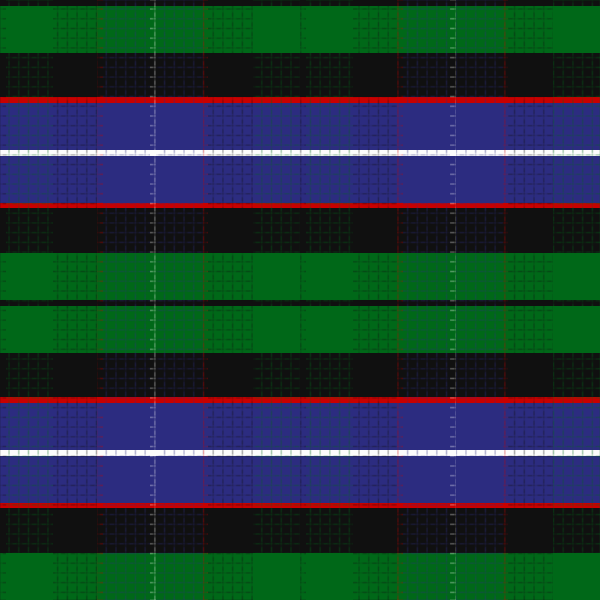
Clan Galbraith tartans
Names and reference numbers follow the Scottish Register of Tartans. Mills sell most setts in modern, ancient and weathered colourways. The pattern is the same; only the shades change.
Get the kilt
When you order a kilt, ask for the tartan by its full name — for example “Galbraith” — and say which colourway you want. “Modern” is dark and strong, “ancient” is lighter, “weathered” is muted. The sett is the same in each.
We are choosing retailers we trust and will list them here soon.
Wear the colours
Our own Galbraith range is on its way: the name, the tartan and the motto on a heavyweight tee, a hoodie and a mug. About the shop.
Lands and seats
- Culcreuch Castle. Near Fintry in Stirlingshire. Held by the chiefly line from about 1320 until it passed to Alexander Seton of Gargunnock, in 1622 to 1624 by different accounts.
- Inchgalbraith. A small island in Loch Lomond with the ruins of a tower. Canmore ascribes the castle to 1542 to 1700, though the dating is debated.
Surnames
The clan name and its spellings
- Galbraith
- Galbreath
- Galbreth
- Gilbreath
- Gilreath
- Calbreath
- Colbreath
- Culbreath
- Kilbreth
- Kulbeth
“Associated” means the name appears in published sept lists for this clan. It does not prove descent, and many names are linked to more than one clan. Where your family lived is often the better clue.
Questions people ask
What is the Galbraith tartan?
The Scottish Register of Tartans records one Galbraith clan tartan, dated 1816. The Register notes that the same sett is also known as Hunter, Mitchell and Russell.
What is the Galbraith motto?
The Clan Galbraith Society uses Ab obice saevior, 'fiercer because of the obstruction'. Some sources give suavior ('gentler') instead, so the spelling is disputed.
Does Clan Galbraith have a chief?
No chief is currently recognised by the Lord Lyon, so the clan is described as armigerous. The Culcreuch line was long regarded as the chiefly family, but it lost its lands in the early seventeenth century.
Where are the Galbraiths from?
Their early home was Inchgalbraith on Loch Lomond, in the old Lennox. The chiefly line later held Culcreuch Castle near Fintry in Stirlingshire.
Sources
- Galbraith (ref. 5127) — Scottish Register of Tartans
- Galbraith Origins — Clan Galbraith Society
- Galbraiths of the Lennox — Clan Galbraith Society
- Membership Application Form — Clan Galbraith Society
- Inchgalbraith — Canmore, Historic Environment Scotland
- Culcreuch Castle — Fintry Museum
- Culcreuch Castle history, 1390 to 1624 — Culcreuch Castle Hotel
Clan histories are contested and sources disagree. If you can correct something here with a source, write to hello@tartanflag.com. Last updated 7 October 2026.