Clan Gordon
The Gordons took their name from a Berwickshire parish and rose to dominate north-east Scotland from Strathbogie. Their chief is the Marquess of Huntly, known as the Cock o' the North.
History
The Gordons are a Border family who became a north-east power. The name comes from Gordon in Berwickshire. The first of the family on record is Richard of Gordon, a lord there around 1200, who is said to have been of Norman descent. His descendant Sir Adam Gordon supported William Wallace and later Robert the Bruce. After Bannockburn in 1314, Bruce gave him the forfeited estate of Strathbogie in Aberdeenshire. The family's future lay there.
A later Sir Adam Gordon was killed at Homildon Hill in 1402, and the inheritance passed by marriage to the Setons. Around 1445 Alexander, 2nd Lord Gordon, was created Earl of Huntly. Some accounts give the date as 1449. He and his heirs took the Gordon name and arms. Within a few years he had beaten the Earl of Crawford at Brechin, in 1452, and the earls of Huntly were on their way to running much of the north.
At their height the Gordons dominated the north-east. Their chief became known as the Cock o' the North. They stayed Catholic after the Reformation, and that brought trouble. The 4th Earl died at the Battle of Corrichie in 1562. In 1594 the Gordons won the Battle of Glenlivet. Five years later, in 1599, James VI made the 6th Earl Marquess of Huntly, and he went on to embellish the palace at Huntly Castle with heraldic carving.
The 2nd Marquess took the royalist side in the civil wars and was beheaded in 1649. In 1684 the 4th Marquess was created Duke of Gordon. In the Jacobite risings of 1715 and 1745 there were Gordons on both sides.
In 1794 the 92nd Regiment, the Gordon Highlanders, was raised, and the 4th Duchess is credited with recruiting for it. The Gordon tartan belongs to this moment. The Duke wanted the Black Watch pattern with a yellow stripe added, and a Huntly weaver, William Forsyth, supplied samples in 1793. The dukedom died out in 1836 when the 5th Duke left no legitimate heir. The marquessate passed to his kinsman the Earl of Aboyne, and the Marquesses of Huntly have been chiefs since, with their seat at Aboyne Castle.
Clan Gordon tartans
Names and reference numbers follow the Scottish Register of Tartans. Mills sell most setts in modern, ancient and weathered colourways. The pattern is the same; only the shades change.
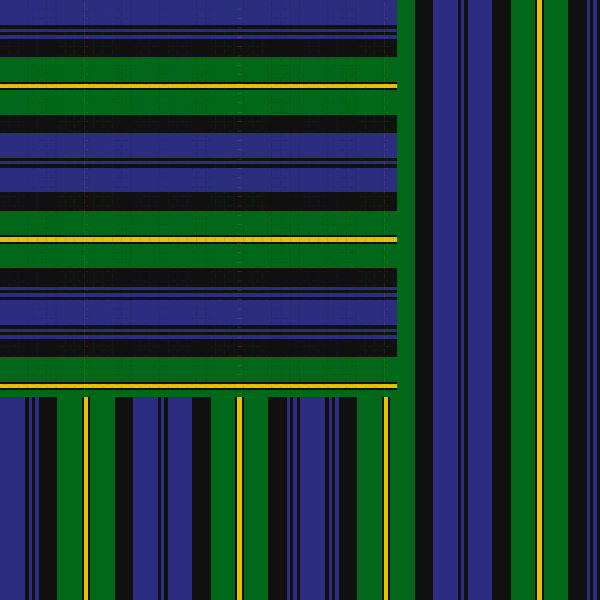 GordonClan tartan · Register ref. 1453
The Black Watch sett with a yellow stripe added, and the regimental tartan of the Gordon Highlanders. The Register records that the 4th Duke of Gordon chose it in 1793 from three patterns offered by William Forsyth, a weaver and outfitter in Huntly.
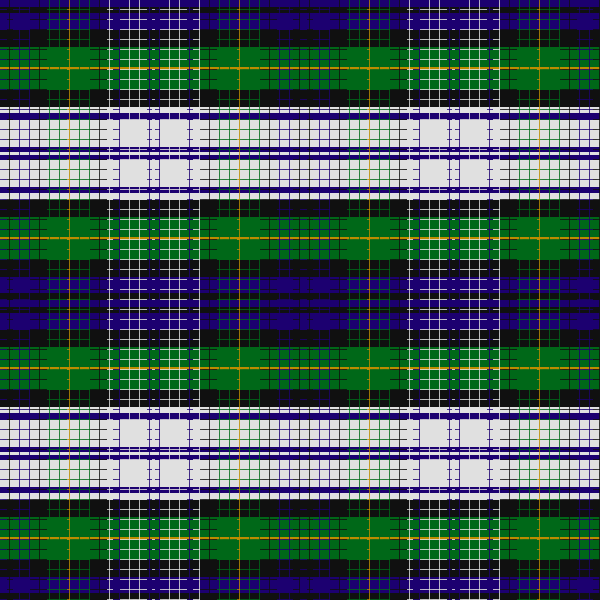 Gordon DressDress tartan · Register ref. 5263
The clan sett opened up with broad white bands. The Register took this count from a 1965 swatch of unknown origin and says it appears closest to the accepted version of Gordon Dress.
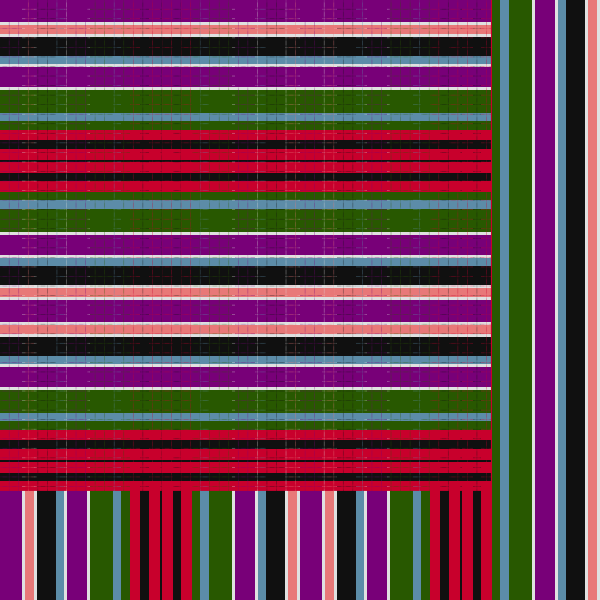 Gordon RedOther sett · Register ref. 1466
An elaborate red, purple and green sett from the Telfer-Dunbar collection. The Register notes that it is also known as 'Old Huntly' and is often used as a Huntly district tartan.
Get the kilt
When you order a kilt, ask for the tartan by its full name — for example “Gordon” — and say which colourway you want. “Modern” is dark and strong, “ancient” is lighter, “weathered” is muted. The sett is the same in each.
We are choosing retailers we trust and will list them here soon.
Wear the colours
Our own Gordon range is on its way: the name, the tartan and the motto on a heavyweight tee, a hoodie and a mug. About the shop.
Lands and seats
- Huntly Castle. The historic seat in Strathbogie, now in the care of Historic Environment Scotland. Robert the Bruce granted the estate to Sir Adam Gordon after Bannockburn.
- Aboyne Castle. On Deeside. Listed as the seat of the Marquesses of Huntly.
Surnames
The clan name and its spellings
- Gordon
Names associated with Clan Gordon
- Huntly
- Huntley
- Adam
- Adie
- Edie
- Eadie
- Aitken
- Atkin
- Badenoch
- Crombie
- Cullen
- Esslemont
- Garioch
- Geddes
- Jessiman
- Jopp
- Laing
- Lawrie
- Meldrum
- Milne
- Moir
- Todd
- Troup
- Laing: A common surname, listed by the House of Gordon USA; a Gordon link should not be assumed for every family.
- Milne: A common surname, listed by the House of Gordon USA; a Gordon link should not be assumed for every family.
“Associated” means the name appears in published sept lists for this clan. It does not prove descent, and many names are linked to more than one clan. Where your family lived is often the better clue.
Questions people ask
What is the Gordon tartan?
The Gordon clan tartan is the dark blue, black and green Black Watch pattern with a yellow stripe. The 4th Duke of Gordon chose it in 1793 and it became the tartan of the Gordon Highlanders. There are also dress and red Gordon setts.
What does the Gordon motto 'Bydand' mean?
Bydand is a Scots word usually translated as 'abiding' or 'steadfast'. An older Gordon motto is 'Animo non astutia', by courage not craft.
Where is Clan Gordon from?
The name comes from Gordon in Berwickshire, but from the 14th century the family's base was Strathbogie in Aberdeenshire, around Huntly Castle. The chief's seat today is Aboyne Castle on Deeside.
Which surnames are associated with the Gordons?
The House of Gordon USA lists many associated names, among them Adam, Adie, Edie, Huntly, Aitken, Crombie, Esslemont, Geddes, Jopp, Meldrum, Milne, Moir, Todd and Troup. Several are common surnames that are also linked with other families.
Sources
- Members: chiefs of clans and names — Standing Council of Scottish Chiefs (clanchiefs.org.uk)
- Huntly Castle: History — Historic Environment Scotland
- Septs — The House of Gordon USA
- Clan Insignia — The House of Gordon USA
- Aboyne Castle — The Castles of Scotland (Martin Coventry)
- Clan Gordon — Electric Scotland
- Marquess of Huntly — Wikipedia (supplementary check)
- Clan Gordon — Wikipedia (supplementary check)
- Scottish Register of Tartans: Gordon Clan — tartanregister.gov.uk
- Scottish Register of Tartans: Gordon Dress (1965) — tartanregister.gov.uk
- Scottish Register of Tartans: Gordon, Red (1819) — tartanregister.gov.uk
Clan histories are contested and sources disagree. If you can correct something here with a source, write to hello@tartanflag.com. Last updated 17 September 2026.