Clan Gray
Gray is a name with a likely French root. Its Scottish line held Longforgan and Fowlis in the Carse of Gowrie, and later Kinfauns. The motto is "Anchor fast anchor". No chief is currently listed.
History
Gray probably has a French root, though sources differ on exactly where. One Electric Scotland account points to the town of Gray in France, while another traces it to Croy, or Gray, in Picardy, granted to Fulbert, chamberlain to Robert, Duke of Normandy. The name may also have begun as a nickname for someone of sallow or grey complexion. A Gray surname alone is no proof of Scottish descent.
Most accounts trace the Scottish line to the Greys of Chillingham in Northumberland. Under William the Lion, it is said, a younger son of that house was given Broxmouth. Grays were settled in the Borders by the late 13th century, and in 1296 two of them gave their oath to Edward I. The family's fortunes turned on Robert the Bruce. In 1312 Bruce's men took Edinburgh Castle in a surprise climb. Sir Andrew Gray went up the rock behind the guide and was the second man onto the walls. His reward was the barony of Longforgan in the Carse of Gowrie.
A later Andrew Gray married Janet, a daughter of Sir Roger de Mortimer, and through her gained Fowlis, west of Dundee. The family became Lords Gray in the 15th century. Electric Scotland places the creation in or before 1437, though the numbering of the early lords varies between accounts. In 1452 Andrew, the second Lord Gray, had royal licence to build Castle Huntly at Longforgan. Tradition holds that he named it after a bride from the Huntly family. The parish history of Longforgan finds no record of that wedding, though, so nobody can be sure where the name came from.
The Lords Gray were close to power, and not always on the winning side. After Sauchieburn, the third lord is said to have been among the mounted men who killed James III. The Longforgan parish history repeats the story, though it is tradition rather than documented fact. He was made hereditary sheriff of Forfar in 1488. The fifth lord backed the Reformation, and Historic Environment Scotland records that in 1547, after Pinkie, his castle at Broughty was handed to the English without a shot. They held it until a Franco-Scottish force drove them out in 1550.
The best-known Gray is Patrick, Master of Gray, a favourite of James VI and his envoy to Elizabeth I in 1584. His part in the affairs around Mary, Queen of Scots in 1586 led to exile. He came back in 1589 but never regained his standing, and later succeeded as Lord Gray. Castle Huntly was sold in 1615. In the 17th century the eighth lord, a Catholic royalist, was fined under Cromwell, and the title passed through his daughter Anne.
The family later settled at Kinfauns, near Perth, which came to them by marriage in 1741. Francis, the fifteenth lord, built Kinfauns Castle in 1822. Other Gray families took root in Sutherland, at Skibo, and in Lanarkshire, at Carntyne. Today COSCA records the motto but lists no chief, and we treat the name as armigerous.
Clan Gray tartans
Names and reference numbers follow the Scottish Register of Tartans. Mills sell most setts in modern, ancient and weathered colourways. The pattern is the same; only the shades change.
Get the kilt
When you order a kilt, ask for the tartan by its full name — for example “Gray Hunting” — and say which colourway you want. “Modern” is dark and strong, “ancient” is lighter, “weathered” is muted. The sett is the same in each.
We are choosing retailers we trust and will list them here soon.
Wear the colours
Our own Gray range is on its way: the name, the tartan and the motto on a heavyweight tee, a hoodie and a mug. About the shop.
Lands and seats
- Castle Huntly, Longforgan. Built under a royal licence of 1452 by Andrew, Lord Gray, according to Electric Scotland's sources. The Grays held it until 1615, and it later returned to the name of Castle Huntly after a spell as Castle Lyon.
- Broughty Castle, near Dundee. Historic Environment Scotland dates the present castle to about 1490 and records Lord Gray as its owner when it passed to the English in 1547. Electric Scotland says the family sold it in 1666.
Surnames
The clan name and its spellings
- Gray
- Grey
- Graye
Names associated with Clan Gray
- Croy
- Groy
- Glas
- Glass
- MacGlashan
- Croy: Listed by COSCA among Gray names. One Electric Scotland account gives Croy as an alternative name for the place in Picardy the family is said to come from.
- Groy: Listed by COSCA among Gray names.
- Glas: Electric Scotland says Glas is equated with Gray.
- Glass: Electric Scotland says Glass is equated with Gray. The name has other origins too.
- MacGlashan: Electric Scotland says many MacGlashans took the name Gray after moving to the Lowlands. The name is also linked with other clans.
“Associated” means the name appears in published sept lists for this clan. It does not prove descent, and many names are linked to more than one clan. Where your family lived is often the better clue.
Questions people ask
What is the Gray tartan?
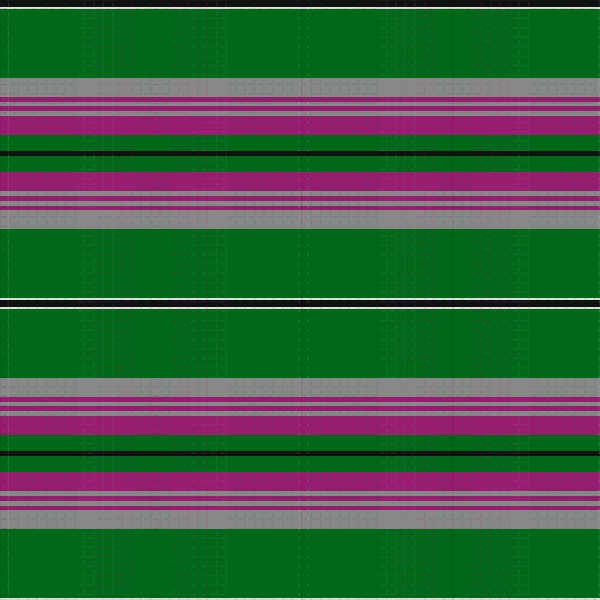
The Scottish Register of Tartans lists Gray Hunting, ref. 1518, dated 2002. It is a green and grey sett with carmine lines, designed after 1986. It is the only Gray tartan the Register lists in the clan and family category.
What is the Gray clan motto?
COSCA gives the motto as "Anchor fast anchor".
Does Clan Gray have a chief?
Neither COSCA nor the Standing Council of Scottish Chiefs lists a chief, so we treat Gray as armigerous. The Lords Gray held the leading place in the name's history from the 15th century.
Which surnames are linked to Gray?
COSCA lists Gray, Graye, Grey, Croy and Groy. Electric Scotland adds that Glas, Glass and MacGlashan are equated with Gray. We treat the names other than spellings of Gray as associated, and some are shared with other families.
Sources
- Gray — COSCA - Council of Scottish Clans & Associations
- Members — Standing Council of Scottish Chiefs
- Gray — Electric Scotland
- Gray history — Electric Scotland
- Gray, Baron (The Scottish Nation) — Electric Scotland
- The Parish of Longforgan, Chapter VI: Castle Huntly — Electric Scotland
- Broughty Castle: history — Historic Environment Scotland
- Gray Hunting (ref. 1518) — Scottish Register of Tartans
Clan histories are contested and sources disagree. If you can correct something here with a source, write to hello@tartanflag.com. Last updated 11 November 2026.