Clan Gunn
A clan of Norse descent, rooted in Caithness and the Strath of Kildonan in Sutherland. Gunn has a recognised chief again, after a gap of more than two centuries.
History
The Gunns look back to the Norse world of the northern earldoms. According to the clan society, the name derives from Gunni, a Norse figure said to have gained lands in Caithness and Sutherland by marrying Ragnhild, a granddaughter of Earl Rognvald of Orkney. The name itself comes from the Old Norse for war or battle. The line of descent is the clan's own account rather than a documented pedigree, and the early generations are thin on hard evidence.
The earliest Gunn chief who can be clearly traced in the records is George Gunn, who served as Crowner (a coroner-like officer) for Caithness in the 1400s. Gaelic tradition called him Am Braisdeach Mor, meaning the great man of the brooch, a reference to his badge of office. He lived at Killearnan, described as a tower house, and at that time the Gunns held real weight in the county.
That strength did not last. As the Sinclairs, Keiths and Sutherlands took up royal grants in the north, the Gunns were pushed off the better ground. The long quarrel with the Keiths is the best known result. Accounts differ on dates: a defeat at Dirlot in Strathmore is placed in 1464, and the chief's death at a meeting at St Tayre's chapel near Ackergill is given as about 1478. Either way, the Crowner and several of his sons were killed.
After George's death the clan divided into separate branches. One went south-west into Sutherland, to the Strath of Kildonan. Others stayed in Caithness. Later centuries brought further loss. The parish of Kildonan, home to Gunn families for generations, was emptied for sheep farming during the Clearances of the early nineteenth century.
The chiefly line then dropped out of view for a long time. Iain Gunn of Banniskirk was recognised by the Lord Lyon as chief in 2015, the first holder of the title in over two centuries. Earlier, in 1978, while serving as Commander of Clan Gunn, he had put his name to a Treaty of Friendship with the chief of Clan Keith, signed at the site of St Tayre's chapel, which closed, at least formally, a feud of roughly five hundred years. He died in October 2024, and his son John became chief in his place.
Clan Gunn tartans
Names and reference numbers follow the Scottish Register of Tartans. Mills sell most setts in modern, ancient and weathered colourways. The pattern is the same; only the shades change.
 GunnClan tartan · Register ref. 1560
The Register dates this sett to 1831, when it appeared in Logan's The Scottish Gael. It was recorded with the Lyon Court on 26 July 1960 by William Gunn of Banniskirk, whose son is Commander of Clan Gunn.
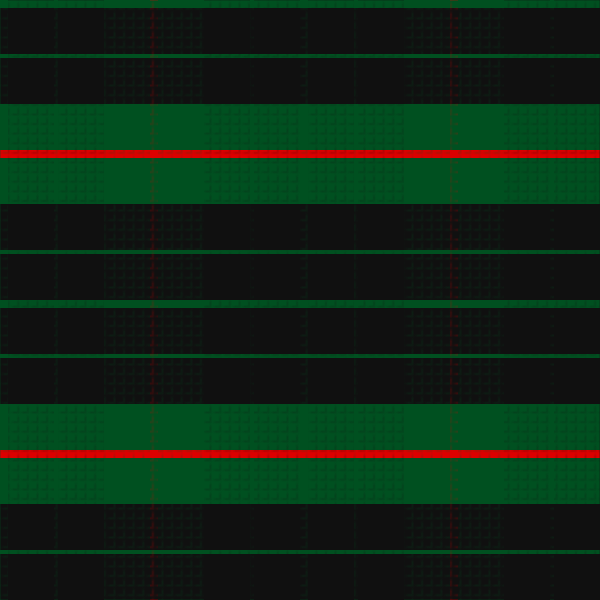 Gunn (Logan)Clan tartan · Register ref. 1561
A green sett with four black bands. The Register notes that Logan showed the inner two bands as blue, a difference print often hides. It places the Gunns, MacKays and Morrisons together as northern and Lewis families, a link reflected in their tartans.
Get the kilt
When you order a kilt, ask for the tartan by its full name — for example “Gunn” — and say which colourway you want. “Modern” is dark and strong, “ancient” is lighter, “weathered” is muted. The sett is the same in each.
We are choosing retailers we trust and will list them here soon.
Wear the colours
Our own Gunn range is on its way: the name, the tartan and the motto on a heavyweight tee, a hoodie and a mug. About the shop.
Lands and seats
- Killearnan. A tower house in Caithness, said to have been the residence of George Gunn, the Crowner, during the 1400s.
Surnames
The clan name and its spellings
- Gunn
Names associated with Clan Gunn
- Gaunson
- Robson
- Robison
- Manson
- Swanson
- Sandison
- Nolson
- Henderson
- Williamson
- Jameson
- Jamieson
- Johnson
- Georgeson
- Keene
- Gallie
- MacCorkill
- Wilson
- Gaunson: Means son of Gunn.
- Robson: Also borne by families with no Gunn connection.
- Robison: Also borne by families with no Gunn connection.
- Manson: Means son of Magnus. Also found in other Highland and island families.
- Swanson: Means son of Sweyn.
- Sandison: Means son of Alexander. Also borne by families with no Gunn connection.
- Nolson: Means son of Neil. Also found as Nelson.
- Henderson: Shared with other clans, including Clan Henderson.
- Williamson: Shared with other clans.
- Jameson: Shared with other clans.
- Jamieson: Shared with other clans.
- Johnson: Shared with many other families.
- Wilson: Shared with other clans.
“Associated” means the name appears in published sept lists for this clan. It does not prove descent, and many names are linked to more than one clan. Where your family lived is often the better clue.
Questions people ask
What is the Gunn tartan?
The Scottish Register of Tartans lists two Gunn setts: Gunn (ref. 1560) and Gunn (Logan) (ref. 1561). Both are green, black and red, with the main sett also using dark blue. The main sett is dated 1831 in the Register.
What is the Gunn clan motto?
The motto is Aut pax aut bellum, Latin for 'either peace or war'. The crest is an arm dressed in Gunn tartan, gripping a basket-hilted sword. The plant badge is juniper.
Does Clan Gunn have a chief?
Yes. Iain Gunn of Gunn was recognised as chief in 2015 and died in October 2024. He was followed by his son, John Gunn of Gunn and Banniskirk, who was received at a ceremony in Edinburgh in April 2025.
Where do the Gunns come from?
The clan is associated with Caithness and the Strath of Kildonan in Sutherland. Its own tradition points to Norse ancestry and the earls of Orkney, though the early generations are not firmly documented.
Sources
- Gunn tartan (ref. 1560) — Scottish Register of Tartans
- Gunn (Logan) tartan (ref. 1561) — Scottish Register of Tartans
- Iain Gunn of Gunn Memorial Service and John Gunn of Gunn Recognition Dinner, April 2025 — Clan Gunn Society
- Clan Gunn chief remembered at service of thanksgiving in Edinburgh — John O'Groat Journal
- History — Clan Gunn Society of North America
- Geography & Castles — Clan Gunn Society of North America
- Gunn Septs — Clan Gunn Society of North America
- Chiefship Investiture — Clan Gunn Society
Clan histories are contested and sources disagree. If you can correct something here with a source, write to hello@tartanflag.com. Last updated 29 September 2026.