Clan Johnstone
A Border clan of Annandale in Dumfriesshire, at times Wardens of the West March and long-standing rivals of the Maxwells. The chief is the Earl of Annandale and Hartfell.
History
The name is a place name: 'John's toun', the settlement of a man called John. The first Johnstone on record is that John's son Gilbert, who received land in Annandale from William Bruce, Lord of Annandale, at some point between about 1195 and 1214. A Johan de Joneston appears on the Ragman Roll of 1296 among the Scots who swore fealty to Edward I of England. There is no grand origin legend here. The Johnstones begin as tenants of the Bruces in a Border valley.
That valley shaped them. Annandale lies on the western road into Scotland, and its families lived by defending it and, often enough, by raiding across it. Johnstone chiefs served at various times as Wardens of the West March. Johnstones are said to have fought the English on the Solway in 1378 and at Otterburn in 1388. In 1455 they backed James II against the Black Douglases, fought at Arkinholm and took part in the siege of Threave Castle. They were rewarded with land, and from then on they were a power in the south-west. In 1542 the laird's lands were made a free barony.
Their great rivals were the Maxwells, who competed with them for the wardenship and for leadership in Dumfriesshire. The feud ran for generations. Lochwood Tower, the Johnstone stronghold near Beattock, was burned. On 6 December 1593 the two sides met at Dryfe Sands near Lockerbie. The Johnstones won decisively. Lord Maxwell was killed, and one account puts the Maxwell dead at around 700. In 1608 Maxwell's son shot Sir James Johnstone dead at a meeting between the two. He was later executed for it in Edinburgh.
After the Union of the Crowns the Border was pacified and the chiefs became peers. James Johnstone was created Lord Johnstone of Lochwood in 1633 and Earl of Hartfell in 1643. He joined Montrose in the civil wars and was captured at Philiphaugh in 1645. After the Restoration his son received the title Earl of Annandale and Hartfell, and in 1701 the family rose again when William Johnstone was made Marquess of Annandale.
The third marquess died unmarried in 1792. The titles fell dormant and the estates passed to the 3rd Earl of Hopetoun, whose line carried the name Hope-Johnstone. Several claims to the titles failed in the nineteenth century. In the early 1980s the Lord Lyon recognised Major Percy Hope Johnstone of Annandale as chief, and in 1985 the House of Lords accepted his son's claim to the earldom of Annandale and Hartfell. The chief's home is Raehills in Annandale.
There is a second, separate family of the name. The Johnstons of Caskieben in Aberdeenshire descend from a Stiven de Johnston who lived in the fourteenth century, and they became baronets of Nova Scotia in 1626. Their crest is a phoenix rather than the winged spur. Many Annandale Johnstones also moved to Ulster from the early 1600s, which is why the name is so common in Northern Ireland and, through later emigration, in North America. The spellings Johnston and Johnstone are used interchangeably, and neither marks a particular branch.
Clan Johnstone tartans
Names and reference numbers follow the Scottish Register of Tartans. Mills sell most setts in modern, ancient and weathered colourways. The pattern is the same; only the shades change.
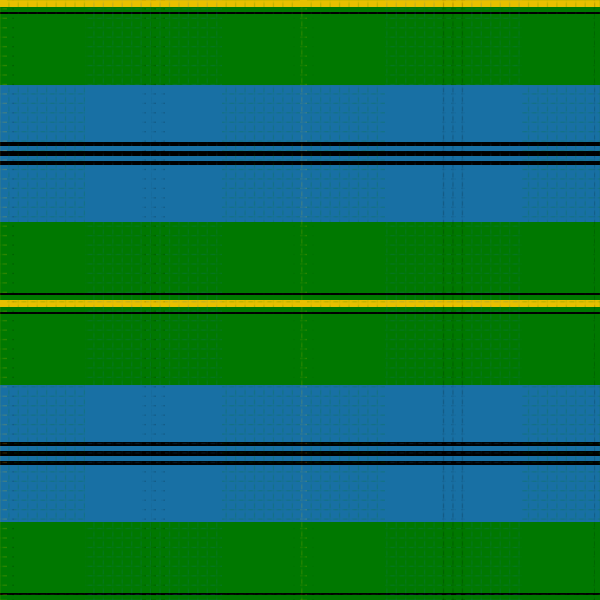 JohnstoneClan tartan · Register ref. 1899
The standard Johnstone sett: broad green and blue bands with narrow black and yellow lines. It first appeared in the Vestiarium Scoticum of 1842, before which Border tartans were generally not named for families. The Register notes that the design may in fact have come from the Aberdeenshire Johnstons of Caskieben.
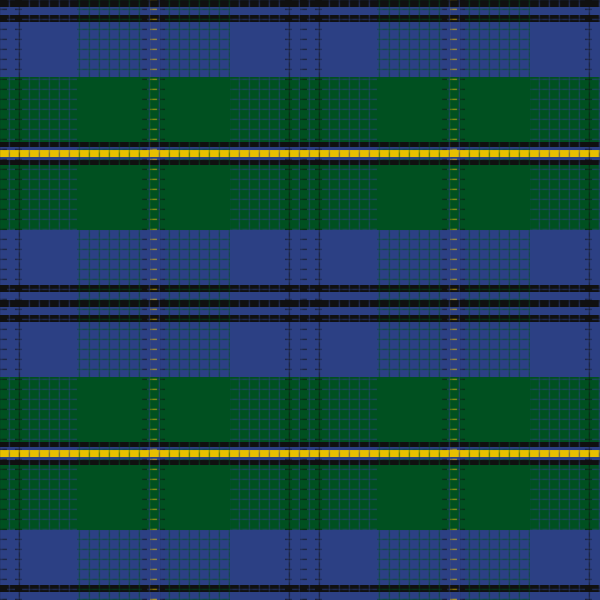 Johnstone (Paton collection)Other sett · Register ref. 1900
A simpler blue, green, black and yellow sett preserved in the Paton collection of Alloa. The samples are undated, but the collection was assembled around the 1830s with later Victorian additions.
Get the kilt
When you order a kilt, ask for the tartan by its full name — for example “Johnstone” — and say which colourway you want. “Modern” is dark and strong, “ancient” is lighter, “weathered” is muted. The sett is the same in each.
We are choosing retailers we trust and will list them here soon.
Wear the colours
Our own Johnstone range is on its way: the name, the tartan and the motto on a heavyweight tee, a hoodie and a mug. About the shop.
Lands and seats
- Lochwood Tower. The old Johnstone stronghold near Beattock in Annandale, burned by the Maxwells in the feud of the late sixteenth century.
- Raehills. The chief's house in Annandale, near Lockerbie.
Surnames
The clan name and its spellings
- Johnstone
- Johnston
- Johnstoun
- Jhonstowne
- Joniston
Names associated with Clan Johnstone
- Marjoribanks
- Marjoribanks: The Clan Marjoribanks Society thinks a descent from the Johnstones of Annandale probable but not proven. Marjoribanks is a separate family with its own chief.
“Associated” means the name appears in published sept lists for this clan. It does not prove descent, and many names are linked to more than one clan. Where your family lived is often the better clue.
Questions people ask
What is the Johnstone tartan?
The usual Johnstone tartan is a green and blue sett with fine black and yellow lines. It was first published in the Vestiarium Scoticum in 1842 and is worn by Johnstones and Johnstons alike.
What is the Johnstone clan motto?
The motto is 'Nunquam non paratus', Latin for 'Never unprepared'. It is sometimes rendered in Scots as 'Aye ready'. The crest is a winged spur.
Is Johnston the same clan as Johnstone?
The two spellings are used interchangeably, and both are covered by the same chief and tartan. There is, however, a separate Aberdeenshire family, the Johnstons of Caskieben, with its own crest of a phoenix.
Where does Clan Johnstone come from?
From Annandale in Dumfriesshire, in the western Scottish Borders. The first recorded Johnstone held land there under the Bruce lords of Annandale around 1200.
Sources
- History of the Clan — Clan Johnston/e in America (clanjohnstone.org)
- Tartan, Crest Badge, Motto and Slogan — Clan Johnston/e in America (clanjohnstone.org)
- Origins — Clan Johnston/e in America (clanjohnstone.org)
- Introduction — The Clan Marjoribanks Society
- Earl of Annandale and Hartfell — Wikipedia
- Clan Johnstone — Wikipedia
- Tartan details: Johnston/Johnstone — The Scottish Register of Tartans
- Tartan details: Johnstone/Johnston — The Scottish Register of Tartans
Clan histories are contested and sources disagree. If you can correct something here with a source, write to hello@tartanflag.com. Last updated 17 September 2026.