Clan Kerr
A Border reiving family split for centuries between two rival houses, Cessford and Ferniehirst, before rising to become the Marquesses of Lothian and the Dukes of Roxburghe.
History
The Kerrs were established in Roxburghshire in the Scottish Borders by around the early fourteenth century, with the family recorded in the forest of Jedburgh from as early as the twelfth. Like their Border neighbours, they were reivers as much as landholders, raiding and feuding across the Anglo-Scottish frontier for generations.
By the fifteenth century the Kerrs had split into two branches, Cessford and Ferniehirst. Both wanted the same prize: control of the Border country and the royal post of Warden of the Middle March. Their rivalry ran deep enough that people still describe it as a feud between two houses rather than a squabble within one family. Each line also carried on feuds outside the family. The most notable was with Clan Scott of Buccleuch, which flared at the Battle of Melrose in 1526, when Scott of Buccleuch attacked to free the young King James V from the custody of the Earl of Angus; a Kerr of Cessford chief was killed in the fighting, and the Kerrs took their revenge by killing Sir Walter Scott of Buccleuch on Edinburgh's High Street in 1552. The feud was eventually resolved when Sir Thomas Kerr of Ferniehirst married a Scott of Buccleuch's sister around 1569.
The two Kerr branches are said to have reconciled with each other rather later, in 1631, when William Kerr of Ferniehirst married Anne Kerr of Cessford. From there the two lines rose in rank on separate paths: the Ferniehirst family became Earls, then Marquesses, of Lothian, while Cessford's descendants became Earls and later Dukes of Roxburghe, still seated today at Floors Castle in Kelso.
The name has even found its way into the language. Being left-handed is still called 'kerr-handed' or 'corrie-fisted' in parts of Scotland, both terms recorded in the Scots dictionaries. Local tradition links this to Ferniehirst itself, claiming the castle's spiral stair winds the opposite way from usual so that a left-handed swordsman defending it would have the advantage. Historians are wary of that particular story: plenty of other Scottish tower houses have stairs winding the same 'wrong' way with no Kerr connection at all, which makes it look more like an ordinary building habit than proof of a family trait.
The chiefship of Clan Kerr continues today in the Marquess of Lothian, whose family seat remains Ferniehirst Castle outside Jedburgh, with the Roxburghe line at Floors Castle standing as the senior cadet branch descended from the old Cessford house.
Clan Kerr tartans
Names and reference numbers follow the Scottish Register of Tartans. Mills sell most setts in modern, ancient and weathered colourways. The pattern is the same; only the shades change.
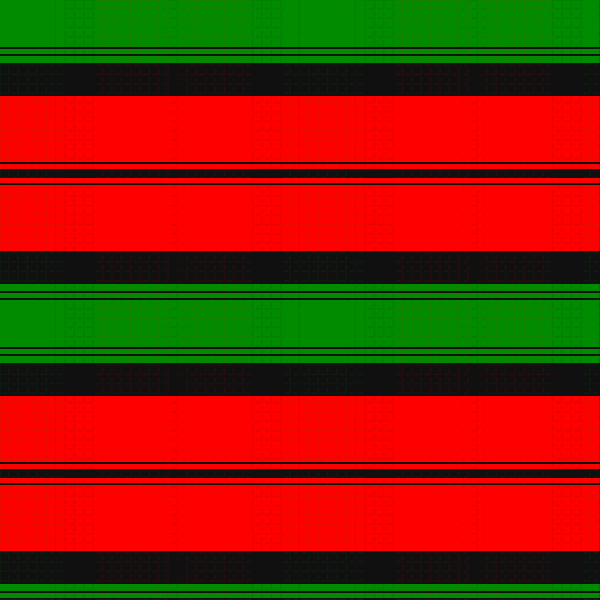 KerrClan tartan · Register ref. 1954
Recorded in the Lyon Court Books from a threadcount given by the Marquess of Lothian, Chief of the Kerrs; first published in the Sobieski Stuarts' Vestiarium Scoticum in 1842.
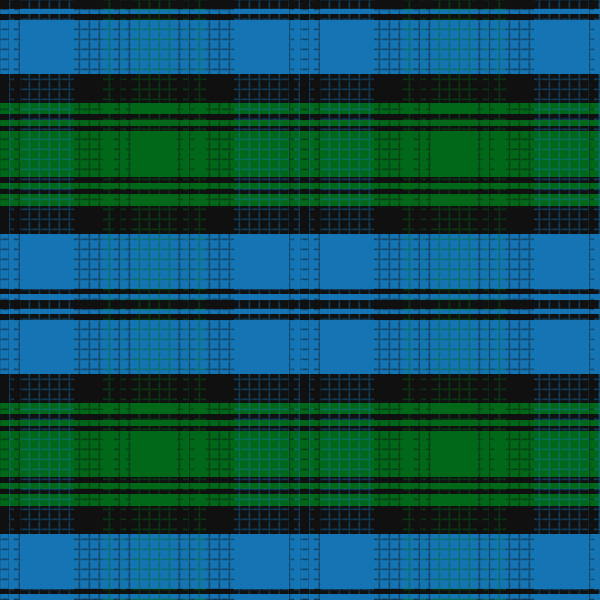 Kerr HuntingHunting tartan · Register ref. 1955
A later hunting sett in black, blue and green, recorded by the Register with a note that this threadcount reflects the pattern's more common modern appearance.
Get the kilt
When you order a kilt, ask for the tartan by its full name — for example “Kerr” — and say which colourway you want. “Modern” is dark and strong, “ancient” is lighter, “weathered” is muted. The sett is the same in each.
We are choosing retailers we trust and will list them here soon.
Wear the colours
Our own Kerr range is on its way: the name, the tartan and the motto on a heavyweight tee, a hoodie and a mug. About the shop.
Lands and seats
- Ferniehirst Castle. Near Jedburgh, built around 1470 and rebuilt by Sir Andrew Kerr in 1598; sacked by an English force in 1523 and recaptured with French help in 1549. Still held by the Marquess of Lothian.
- Floors Castle. At Kelso, seat of the Dukes of Roxburghe, the senior line descended from the Cessford branch. Built in the 1720s and remodelled in the nineteenth century.
Surnames
The clan name and its spellings
- Kerr
- Ker
- Carr
- Kar
- Kerre
“Associated” means the name appears in published sept lists for this clan. It does not prove descent, and many names are linked to more than one clan. Where your family lived is often the better clue.
Questions people ask
What is the Kerr tartan?
The main Kerr tartan is a green sett with black and dark red lines, first published in the Vestiarium Scoticum in 1842 and later recorded in the Lyon Court Books from a threadcount supplied by the Marquess of Lothian. A separate Kerr Hunting tartan, in black, blue and green, is also registered.
What is the Kerr motto and crest?
The chiefly motto is 'Sero sed serio', Latin for 'Late but in earnest'; other Kerr lines have carried different mottoes down the centuries. The crest badge shows a sun in splendour, shown gold.
Why were the Kerrs split into two branches?
By the fifteenth century the family had divided into Kerr of Cessford and Kerr of Ferniehirst, rivals for local power and for the Border warden's office. The two houses eventually reconciled by marriage in 1631; Ferniehirst's line became the Marquesses of Lothian, and Cessford's became the Dukes of Roxburghe.
Where is Clan Kerr from?
The clan's heartland is Roxburghshire in the Scottish Borders, around Jedburgh and the Jed Water valley. Ferniehirst Castle, the chief's seat, stands just outside Jedburgh; Floors Castle at Kelso is the seat of the related Roxburghe line.
Sources
- History of Ferniehirst Castle — Ferniehirst Castle
- History — Floors Castle
- Ferniehirst Castle — Lothian Estates
- 'Corrie-handed', 'kerr-handed' — Dictionaries of the Scots Language
- Ferniehirst Castle, Roxburghshire — a Borders seat designed for left-handed people? — Country Life
- Mediaeval Mythbusting: the left-handed Kerrs — Triskele Heritage
- Ralph Kerr succeeds to the title of Marquess of Lothian — The Constantinian Order (UK Commission)
- Scottish Register of Tartans: Kerr — tartanregister.gov.uk
- Scottish Register of Tartans: Kerr Hunting — tartanregister.gov.uk
Clan histories are contested and sources disagree. If you can correct something here with a source, write to hello@tartanflag.com. Last updated 18 September 2026.