Clan Lockhart
A Lowland Lanarkshire family famed for the Lee Penny talisman and the Lee Castle estate, recognised today by the Lord Lyon as a clan with a modern (1996) tartan.
History
Lockhart traces back to an older surname, Locard, carried by a family with likely Flemish or Norman roots that had put down stakes in Lanarkshire well before the year 1200. Early records spell the name Lokart, Locard or Lokhart, and the family's oldest surviving charter, dated 1323, has Sir Symon Locard and his heirs agreeing to pay rent from the lands of Lee and Cartland in South Lanarkshire. Within a generation the Locards of Lee were substantial landholders in the upper Clyde valley, a position the family has held in one form or another for close to seven hundred years.
The name changed to its modern form in the fourteenth century, and family tradition explains why. After Robert the Bruce died in 1329, Sir James Douglas is said to have set out to carry the king's embalmed heart to the Holy Land, honouring a deathbed wish. Sir Symon Locard, 2nd of Lee, reportedly rode with him and carried the key to the silver casket holding the heart. Douglas was killed fighting in Spain before the party reached Jerusalem, and Locard is said to have brought the heart home for burial at Melrose. A heart enclosed in a fetterlock was worked into the family's arms, the surname shifted to Lockheart and then Lockhart, and the motto Corda Serrata Pando, 'I open locked hearts', was adopted as a pun on the new name.
The same campaign is said to have produced the Lee Penny. Tradition holds that Locard took a Moorish nobleman prisoner, and when the man's mother arrived to settle his ransom, a stone mounted in a coin slipped from her purse. Her eagerness to snatch it back told Locard it must be valuable, so he insisted it be handed over with the rest of the payment. The stone, said to cure certain ailments when dipped in water, stayed with the family and inspired Sir Walter Scott's 1825 novel The Talisman. Like the heart story, this is inherited tradition rather than documented record, but it has shaped the family's identity for centuries.
Beyond Lee, the family later acquired the barony of Carnwath and held land across Ayrshire, Dumfriesshire and Peeblesshire. Lee Castle itself eventually left the family's ownership, though the Lockharts still hold other land nearby and the Carnwath title.
Several Lockharts made their mark well beyond Lanarkshire. Sir George Lockhart of Carnwath rose to become Lord President of the Court of Session in the 1680s before being murdered by a disgruntled litigant in 1689. His son, also George Lockhart of Carnwath, sat in the final Parliament of Scotland, worked secretly for the Jacobite cause after the Union, and left behind the Lockhart Papers, still used by historians of the period. In the nineteenth century, John Gibson Lockhart, who married Sir Walter Scott's daughter, edited the Quarterly Review and wrote the standard biography of his father-in-law.
Lockhart is a Lowland family rather than a historic Highland clan, but it is recognised today by the Lord Lyon, and current sources name Ranald Lockhart of the Lee as chief - styled 27th of the Lee by Burke's Peerage and the Roll of the Baronage of Scotland, though the American Clan Lockhart Society gives 28th. The Clan Lockhart Society and the American Clan Lockhart Society keep the wider family connected worldwide. The American Clan Lockhart Society notes Lockhart has no traditional septs or sub-branches in the usual sense - only historic spellings of the name.
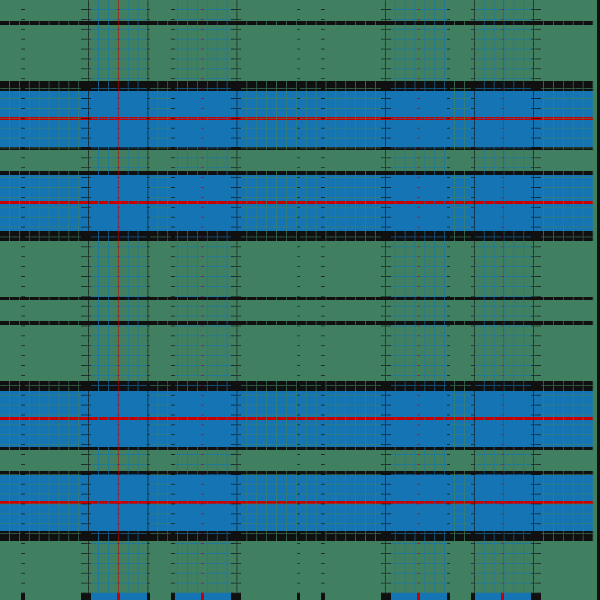
Clan Lockhart tartans
Names and reference numbers follow the Scottish Register of Tartans. Mills sell most setts in modern, ancient and weathered colourways. The pattern is the same; only the shades change.
Get the kilt
When you order a kilt, ask for the tartan by its full name — for example “Lockhart” — and say which colourway you want. “Modern” is dark and strong, “ancient” is lighter, “weathered” is muted. The sett is the same in each.
We are choosing retailers we trust and will list them here soon.
Wear the colours
Our own Lockhart range is on its way: the name, the tartan and the motto on a heavyweight tee, a hoodie and a mug. About the shop.
Lands and seats
- Lee Castle. Near Lanark. A castle here is said to have been built by William Locard around 1272 and was rebuilt on a much larger scale in the 19th century. It served as the Lockhart family seat for generations but is no longer in family hands, though the family still holds other land in the area.
Surnames
The clan name and its spellings
- Lockhart
- Locard
- Lokart
- Lokhart
- Lockheart
- Lockard
- Lochart
- Lochard
“Associated” means the name appears in published sept lists for this clan. It does not prove descent, and many names are linked to more than one clan. Where your family lived is often the better clue.
Questions people ask
Is Lockhart a real Scottish clan?
Yes, but with a caveat worth knowing: Lockhart is a Lowland family, not one of the old Highland clans, and it did not have a clan tartan until 1996. It is, however, formally recognised by the Court of the Lord Lyon as a clan with a chief, which puts it on firmer footing than many surnames that are only loosely 'associated with' a clan.
Where does the Lockhart name come from?
The surname grew out of an older one, Locard, borne by a family with likely Flemish or Norman roots who had established themselves in Lanarkshire before 1200. By the fourteenth century the spelling had shifted to Lockheart and then Lockhart, a change family tradition ties to Sir Symon Locard's role in carrying Robert the Bruce's heart towards the Holy Land.
What does the Lockhart motto mean?
The motto is Corda Serrata Pando, Latin for 'I open locked hearts'. It is a deliberate pun: 'lock' echoes the family name, and 'hearts' points to the heart-within-a-fetterlock device in the Lockhart arms, tied to the Bruce's-heart legend.
When was the Lockhart tartan created, and is it historic?
It is a modern design, created for the chief in 1996 and registered with the Lord Lyon the same year. It is not an ancient sett - the Lockharts, as a Lowland family, never had a historic tartan - but it is the only Lockhart tartan on the Scottish Register of Tartans.
Sources
- History — Clan Lockhart Society
- Tartan — Clan Lockhart Society
- About - Ranald Lockhart of the Lee — American Clan Lockhart Society
- History of the Lockharts — American Clan Lockhart Society
- Lockhart — Council of Scottish Clans & Associations (COSCA)
- Ronald Lockhart - Baron of Carnwath — The Roll of the Baronage of Scotland
- Lockhart, reference 2179 — The Scottish Register of Tartans
- John Gibson Lockhart — Encyclopaedia Britannica
- LOCKHART, George (1681-1731), of Carnwath, Lanark., and Dryden, Edinburgh. — History of Parliament Online
Clan histories are contested and sources disagree. If you can correct something here with a source, write to hello@tartanflag.com. Last updated 24 September 2026.