Clan MacIntyre
Clann an t-Saoir
A clan from Glen Noe on Loch Etive, with branches in Lorn, Appin and Badenoch. The name means 'son of the carpenter', and the chiefship is held by MacIntyre of Glenoe.
History
MacIntyre comes from the Gaelic Mac an t-Saoir, 'son of the carpenter'. One tradition ties the family to the Hebrides and to Maurice, a nephew of Somerled, the twelfth-century lord of the isles. Another, humbler account says the name began with a MacDonald who held land in Kintyre, whose son is said to have settled at Degnish in Lorn. Neither can be proved, and the clan association itself describes the origins as uncertain.
The chiefly family took its title from Glen Noe, which lies on the south side of Ben Cruachan and runs down to Loch Etive in Ardchattan parish. Local legend has the first MacIntyre sailing in by galley with a white cow, and making his home at the place where the animal lay down. That spot is still called Làrach na Bà Bàine, the site of the white cow. Accounts put the arrival from the thirteenth century or earlier, so the date stays open.
The MacIntyres of Glenoe are said to have been hereditary foresters for many generations. Their overlords changed as power in Lorn passed from the MacDougalls to the Stewarts and then the Campbells, and the family eventually held Glen Noe as Campbell tenants. Tradition records the rent as a fat calf at Christmas and, at midsummer, a snowball brought down from Ben Cruachan. Over time these tokens were commuted to a payment in money.
One branch moved east to Badenoch. Clan accounts date this to the late fifteenth century, when these MacIntyres were taken into the Clan Chattan confederation. Other families stayed nearer Appin and Lorn, and several MacIntyres are recorded fighting beside the Stewarts of Appin at Culloden. The best-known clansman of the age is the Gaelic poet Duncan Ban MacIntyre, remembered as Fair Duncan of the Songs, who fought on the government side at Falkirk in 1746.
As the money rent climbed, the chiefs could no longer meet it. In 1806 the tenancy of Glen Noe was given up, and the family later emigrated to America. Sources differ slightly on the dates of the last chief to live there and the last MacIntyre in the glen, placing them in the early nineteenth century and in 1876. The chiefship then lay dormant for a long time. In the early 1990s the Lord Lyon recognised MacIntyre of Glenoe as Chief of the Name and Arms, though sources differ between 1990 and 1991. We have not confirmed who holds the style today, so we give the style alone.
Clan MacIntyre tartans
Names and reference numbers follow the Scottish Register of Tartans. Mills sell most setts in modern, ancient and weathered colourways. The pattern is the same; only the shades change.
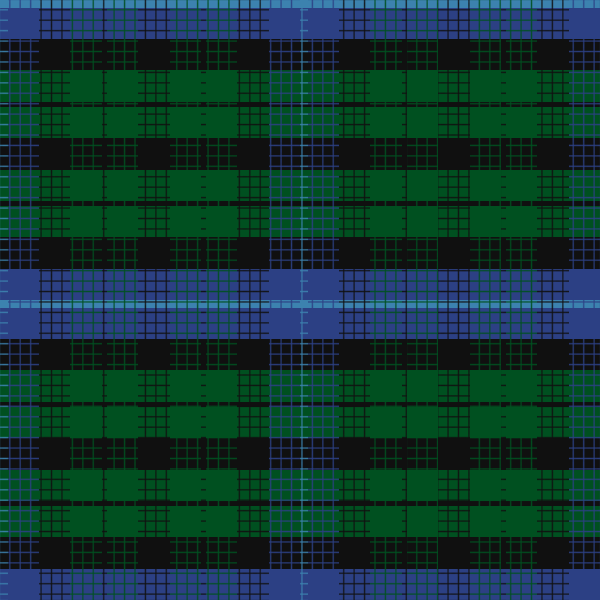 MacIntyreClan tartan · Register ref. 2483
The Register has no firm date for this sett. It comes from an unmarked sample in the MacGregor-Hastie collection, which is thought to date from between 1930 and 1950.
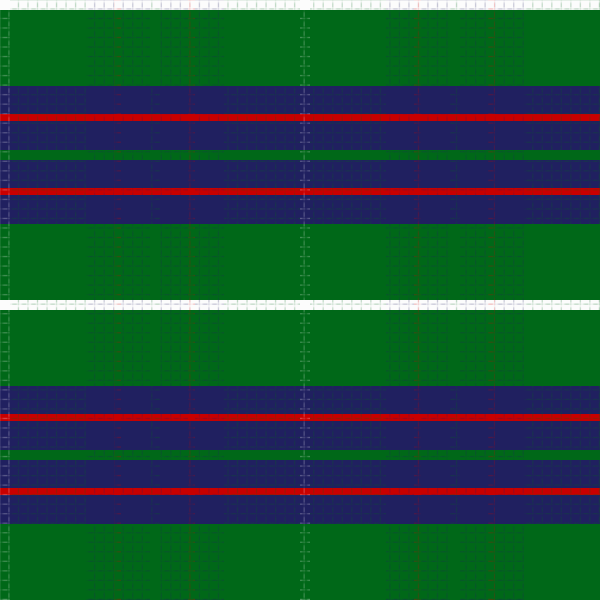 MacIntyre Hunting (VS)Hunting tartan · Register ref. 2485
The Register notes a doublet in Kingussie Museum, dated 1800, in this sett. It also appeared in the Vestiarium Scoticum of 1842 and was recorded in the Lord Lyon's Register in December 1955. The 1840 date is the Register's.
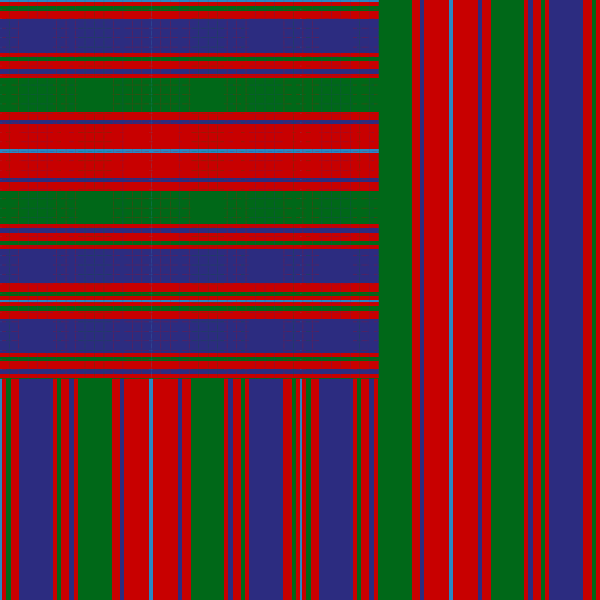 MacIntyre (of Gatehouse)Other sett · Register ref. 2484
Named for MacIntyre of Gatehouse, Inveraray, for whom the Edinburgh firm Meyer and Mortimer made it. W and A Smith printed it in 1859 and admitted they found it hard to get any authoritative MacIntyre sett. It differs from the one recorded by the Lord Lyon but is the version most often woven today.
Get the kilt
When you order a kilt, ask for the tartan by its full name — for example “MacIntyre” — and say which colourway you want. “Modern” is dark and strong, “ancient” is lighter, “weathered” is muted. The sett is the same in each.
We are choosing retailers we trust and will list them here soon.
Wear the colours
Our own MacIntyre range is on its way: the name, the tartan and the motto on a heavyweight tee, a hoodie and a mug. About the shop.
Lands and seats
- Glen Noe. The historic seat of the chiefs, on the south side of Ben Cruachan above Loch Etive in Ardchattan parish. The tenancy was given up in 1806.
Surnames
The clan name and its spellings
- MacIntyre
- McIntyre
- MacIntire
- MacKintyre
- McEntire
- MacTear
- MacTeer
- MacTier
- MacTire
Names associated with Clan MacIntyre
- Tyre
- Tyrie
- Tyree
- MacCosham
- MacCoiseam
- McAntara
- Wright
- Wright: An English form of the trade name, also borne by many families with no MacIntyre link.
“Associated” means the name appears in published sept lists for this clan. It does not prove descent, and many names are linked to more than one clan. Where your family lived is often the better clue.
Questions people ask
What is the MacIntyre tartan?
The Scottish Register of Tartans lists several MacIntyre setts. We show the main sett (ref. 2483), the hunting sett (ref. 2485) and MacIntyre of Gatehouse (ref. 2484). The hunting sett has the earliest documented date, 1840 in the Register.
What is the MacIntyre clan motto?
The motto is Per ardua, Latin for 'through difficulties'. The crest is a right hand holding an upright dagger. The plant badge is given as white heather, though older works name common heath.
What surnames are linked to Clan MacIntyre?
Variants of the name include McIntyre, MacTear and McEntire. Names such as Tyre, Tyrie, MacCosham and Wright appear in sept lists. Many of these are also found outside the clan, so a surname alone proves nothing.
Where do the MacIntyres come from?
The chiefs took their title from Glen Noe by Loch Etive in Argyll. Other branches settled in Lorn, Appin and Badenoch. Early origins are traditional, with a link to the Hebrides.
Sources
- MacIntyre tartan (ref. 2483) — Scottish Register of Tartans
- MacIntyre (of Gatehouse) tartan (ref. 2484) — Scottish Register of Tartans
- MacIntyre Hunting (VS) tartan (ref. 2485) — Scottish Register of Tartans
- About — Clan MacIntyre Association
- History of the MacIntyre Clan: Introduction — Electric Scotland
- MacIntyre, McIntyre — Ardchattan Parish Archive
- Septs of Clan MacIntyre — Family and Scottish Clan Heritage, Nova Scotia (chebucto.ns.ca)
Clan histories are contested and sources disagree. If you can correct something here with a source, write to hello@tartanflag.com. Last updated 2 October 2026.