Clan Mackenzie
Clan Mackenzie rose from Kintail in Wester Ross to hold much of Ross-shire and the Isle of Lewis. Its chief is the Earl of Cromartie, styled Cabarfèidh, whose seat is Castle Leod.
History
Mackenzie means son of Kenneth, and older writers call the clan simply Clan Kenneth. Its home was Kintail in Wester Ross. For a long time the clan's own histories claimed descent from Colin Fitzgerald, an Irish-Norman adventurer supposedly rewarded with Kintail after the Battle of Largs in 1263. The historians Cosmo Innes and William Skene showed that the charter behind that story was a forgery. A Gaelic genealogy of about 1450 gives a native descent instead, from Gilleoin of the Aird, an ancestor shared with the old Earls of Ross. The Gaelic account is now the one generally preferred, though it cannot be proved in detail either.
A Murdoch, son of Kenneth, is said to have had a charter from David II in 1362. The first chief who appears clearly in the records is Alexander Mackenzie of Kintail, in the 1460s. He is remembered as Alexander the Upright and is said to have died in 1488 at a great age. Around 1491 the clan fought the MacDonalds at Blàr na Pàirce. The clan's war cry, Tulach Àrd, 'the high hill', recalls a gathering place in Kintail where beacon fires were lit.
The next century was one of steady gain. Kenneth Mackenzie was created Lord Mackenzie of Kintail in 1609. Around the same time, after years of trying, the clan gained the Isle of Lewis. In 1623 Colin Mackenzie became Earl of Seaforth, and Brahan Castle was a seat of the Seaforth chiefs. A separate branch of the family later held the earldom of Cromartie.
The Seaforth chiefs were loyal to the Stuarts and paid for it. William, the 5th Earl, came out in 1715 and again in 1719, when the Jacobites were beaten at Glen Shiel. His titles were forfeited. In 1745 the clan was split. Lord Fortrose held to the government, while the 3rd Earl of Cromartie raised men for Prince Charles.
In 1778 the then Earl of Seaforth raised the Seaforth Highlanders, and the Mackenzie tartan we know is that regiment's tartan. The senior line ended in 1815 with the death of Francis Humberston Mackenzie, Lord Seaforth. Tradition ties the end of the line to the Brahan Seer, who is said to have foretold the doom of the Seaforths. The Lord Lyon recognised the Earl of Cromartie as chief in 1980, according to the clan society; some accounts say 1979. The present Earl lives at Castle Leod near Strathpeffer.
Clan Mackenzie tartans
Names and reference numbers follow the Scottish Register of Tartans. Mills sell most setts in modern, ancient and weathered colourways. The pattern is the same; only the shades change.
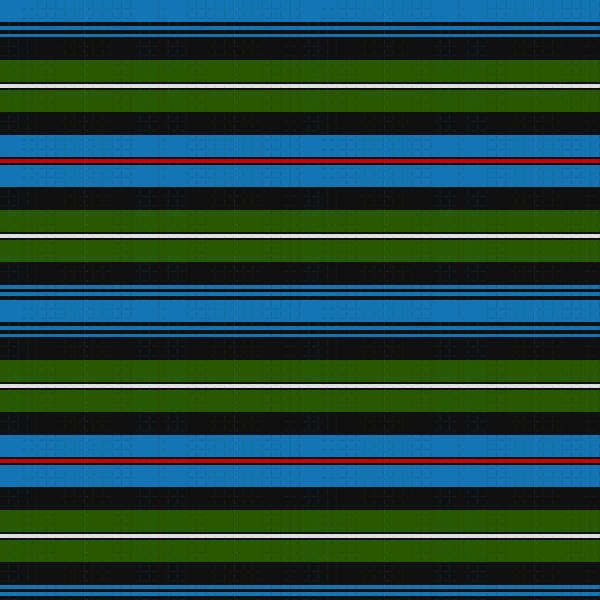 MackenzieClan tartan · Register ref. 2520
A Black Watch-type sett of blue, black and green with alternating white and red lines. It is the regimental tartan of the Seaforth Highlanders, raised by Mackenzie, Earl of Seaforth, in 1778. The Register notes that the threadcount was recorded in the Lyon Court's register in 1949.
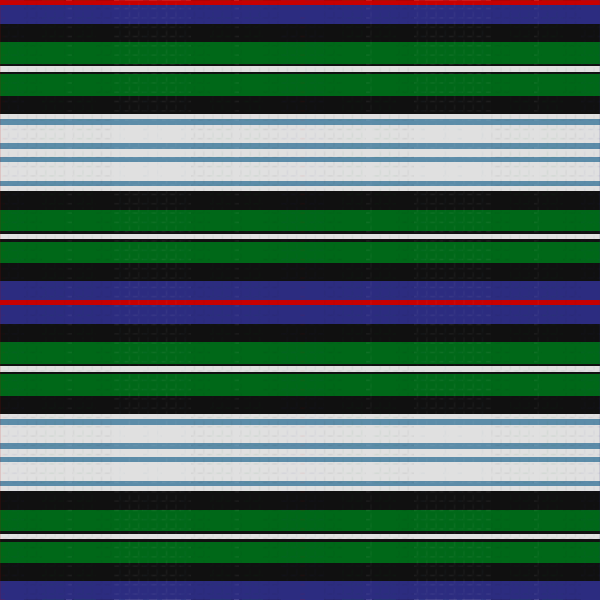 Mackenzie DressDress tartan · Register ref. 2524
The clan sett lightened with broad white bands. The Register credits the threadcount to James Cant, who died in 1960, and notes that some weavers use black lines on the white where others use azure or blue.
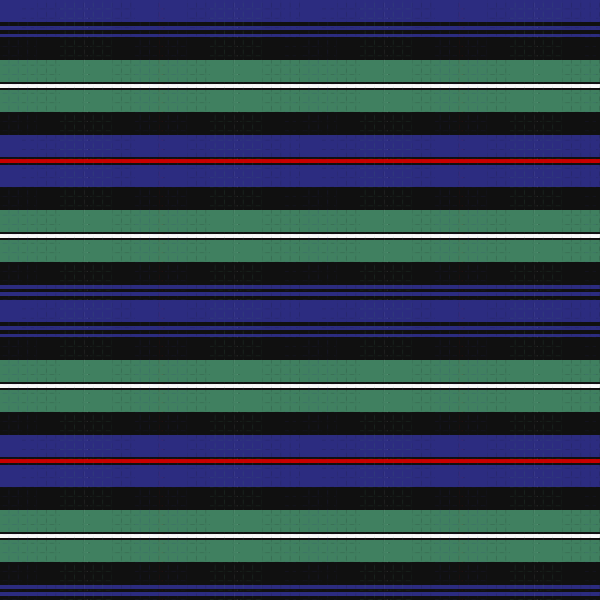 Mackenzie HuntingHunting tartan · Register ref. 2529
The clan sett in softened, weathered shades. The Register notes that the Clan Mackenzie Society in the UK calls it 'muted green' and that it is treated as a hunting tartan.
Get the kilt
When you order a kilt, ask for the tartan by its full name — for example “Mackenzie” — and say which colourway you want. “Modern” is dark and strong, “ancient” is lighter, “weathered” is muted. The sett is the same in each.
We are choosing retailers we trust and will list them here soon.
Wear the colours
Our own Mackenzie range is on its way: the name, the tartan and the motto on a heavyweight tee, a hoodie and a mug. About the shop.
Lands and seats
- Castle Leod. At Strathpeffer in Ross-shire. Seat of the Earl of Cromartie, the present chief.
- Brahan Castle. Historic seat of the Seaforth line of chiefs.
- Eilean Donan Castle. In Kintail, where Loch Duich meets Loch Long. The clan's old stronghold rather than a seat today.
Surnames
The clan name and its spellings
- Mackenzie
- MacKenzie
Names associated with Clan Mackenzie
- Kenneth
- Kennethson
- MacConnach
- Charleson
- MacKerlich
- Clunes
- Clunies
- Cross
- Iverach
- Ivory
- MacIver
- MacIvor
- MacBeolain
- MacBeth
- MacLeay
- MacMurchie
- Murchison
- Murchie
- MacVanish
- MacVinish
- Smart
- Tuach
- MacIver: Also listed as a sept of Clan Campbell.
“Associated” means the name appears in published sept lists for this clan. It does not prove descent, and many names are linked to more than one clan. Where your family lived is often the better clue.
Questions people ask
What is the Mackenzie tartan?
The Mackenzie tartan is a dark blue, black and green sett with alternating white and red lines. It is also the regimental tartan of the Seaforth Highlanders, raised by the Earl of Seaforth in 1778. Dress and muted hunting versions exist too.
What is the Clan Mackenzie motto?
The chief's motto is 'Luceo non uro', Latin for 'I shine, not burn', with a crest of a mountain in flames. 'Cuidich 'n Righ', Gaelic for 'Help the King', is the motto associated with the Seaforth line.
Where is Clan Mackenzie from?
Kintail in Wester Ross. From there the clan spread across Ross-shire and to the Isle of Lewis. The chief's seat today is Castle Leod at Strathpeffer.
Which surnames are associated with Clan Mackenzie?
The Clan Mackenzie Society lists names such as Kenneth, Kennethson, MacConnach, Charleson, Clunes, Cross, Iverach, MacIver, MacLeay, MacMurchie, Murchison, MacVinish, Smart and Tuach. The society says its list is under review, and many entries are spelling variants of a few names.
Sources
- Members: chiefs of clans and names — Standing Council of Scottish Chiefs (clanchiefs.org.uk)
- Clan Chief — Clan Mackenzie Society of Scotland and the UK
- Septs — Clan Mackenzie Society of Scotland and the UK
- Badges — Clan Mackenzie Society in Australia
- Septs of Clan Campbell — Clan Campbell Society (North America)
- Clan Mackenzie — Electric Scotland
- Clan Mackenzie — Wikipedia (supplementary check)
- Scottish Register of Tartans: Mackenzie — tartanregister.gov.uk
- Scottish Register of Tartans: MacKenzie Dress — tartanregister.gov.uk
- Scottish Register of Tartans: MacKenzie Hunting (Green) — tartanregister.gov.uk
Clan histories are contested and sources disagree. If you can correct something here with a source, write to hello@tartanflag.com. Last updated 17 September 2026.