Clan MacKinnon
An island clan of Skye and Mull, said to descend from the royal house of Alpin. The MacKinnons gave abbots to Iona and sheltered Prince Charles Edward Stuart in 1746.
History
The MacKinnons count themselves part of Siol Alpin, the clans that claim descent from the royal line of Alpin. Clan tradition names Findanus, said to be of the ninth century, as an early forebear and the source of the name. This pedigree cannot be tested against early documents, and it stands as tradition.
The place most tied to the early clan is Dunakin, a fortress on the Skye shore near Kyleakin. A well-known story gives it to a Norse princess, Saucy Mary, who is said to have stretched a chain across the narrows at Kyle and charged ships a toll to pass. It is a tale rather than a record. What the sources do show is that by the late 1500s the chiefs had moved from Dunakin to Kilmorie, near Dun Ringill.
In the days of the Lords of the Isles the MacKinnon chiefs had a seat on the Council of the Isles. The family held lands in Strath on Skye, built up its hold on Mishnish in the north of Mull, and kept a farm at Sliddery on Arran. The Church was close to the clan as well, and several MacKinnons are said to have been abbots of Iona.
The MacKinnons were for the Stuarts. After Culloden in April 1746 the chief, Iain Og MacKinnon, by then an old man, helped the fugitive prince cross from Skye to the mainland by boat. He was soon arrested and imprisoned, on a ship at Tilbury and in the fort, and was pardoned in the end because of his age. Accounts differ on how long he was held, from about a year to several years.
That loyalty left the family in debt, and the land slipped away. The last estates were sold by 1791, and the MacKinnons no longer held ground on Skye or Mull. Many clan families emigrated in the years after, to Canada, the United States and Australia, while others stayed on in the islands.
The chiefship outlasted the land. The clan today has a chief recognised by the Lord Lyon, styled MacKinnon of MacKinnon, and a society with members on both sides of the Atlantic. The motto is a later addition: clan accounts say it began as the personal motto of a MacKinnon branch settled in Antigua, and was joined to the older crest when the arms were registered in 1811, though the details vary. The older badges are the Scots pine and St John's wort.
Clan MacKinnon tartans
Names and reference numbers follow the Scottish Register of Tartans. Mills sell most setts in modern, ancient and weathered colourways. The pattern is the same; only the shades change.
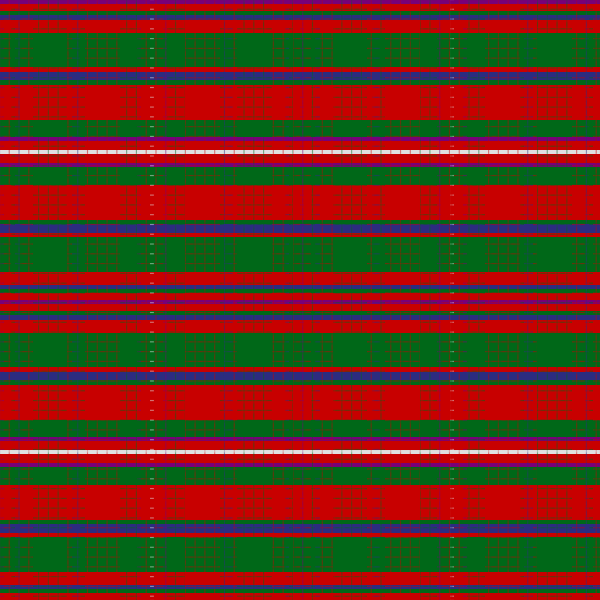 MacKinnonClan tartan · Register ref. 2542
The Register describes a confusing history, with five versions in five major works. The sett shown here was recorded with the Lord Lyon on 9 December 1960 and is traced to a Highland Society of London sample of about 1816. The Register also notes that navy is often used in place of the purple in the Lyon count.
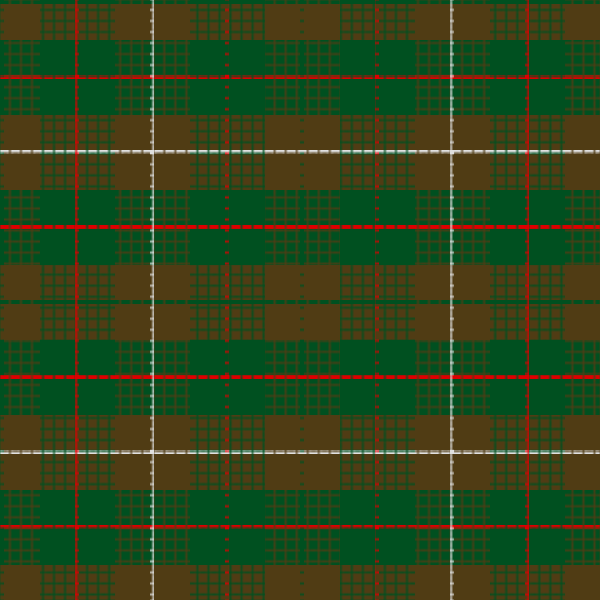 MacKinnon HuntingHunting tartan · Register ref. 2555
A green and brown sett with a thin red line. The Register says it follows a design published in the Vestiarium Scoticum in 1842, with brown replacing the red of that version. It was registered with the Lord Lyon in 1960.
Get the kilt
When you order a kilt, ask for the tartan by its full name — for example “MacKinnon” — and say which colourway you want. “Modern” is dark and strong, “ancient” is lighter, “weathered” is muted. The sett is the same in each.
We are choosing retailers we trust and will list them here soon.
Wear the colours
Our own MacKinnon range is on its way: the name, the tartan and the motto on a heavyweight tee, a hoodie and a mug. About the shop.
Lands and seats
- Dunakin (Caisteal Maol). Also called Castle Findanus, near Kyleakin on Skye. Tradition links it to a Norse princess known as Saucy Mary.
- Kilmorie. Near Dun Ringill on Skye. Sir Lachlan MacKinnon, who signed the Statutes of Iona in 1609, lived here.
Surnames
The clan name and its spellings
- MacKinnon
- Kinnon
- MacInnon
Names associated with Clan MacKinnon
- MacKinney
- MacKinning
- MacKinven
- MacInven
- MacMorran
- Love
- MacSherrie
- Sherry
- Sherrie
- MacKinney: Listed as a sept in lists dating from 1958.
- MacKinning: Listed as a sept in lists dating from 1958.
- MacKinven: Listed as a sept in lists dating from 1958.
- MacMorran: Listed as a sept in lists dating from 1958.
- Love: Listed as a sept in lists dating from 1958. Some MacKinvens are said to have adopted Love as an English form. Also borne by families with no MacKinnon link.
- Sherry: Also borne by families with no MacKinnon link.
- Sherrie: Also borne by families with no MacKinnon link.
“Associated” means the name appears in published sept lists for this clan. It does not prove descent, and many names are linked to more than one clan. Where your family lived is often the better clue.
Questions people ask
What is the MacKinnon tartan?
The Scottish Register of Tartans lists MacKinnon (ref. 2542) and MacKinnon Hunting (ref. 2555). The clan sett is blue, purple, red, green and white and is dated 1816 in the Register. The hunting sett is green and brown.
What is the MacKinnon clan motto?
The motto is Audentes fortuna juvat, Latin for 'fortune assists the daring'. Clan accounts say it began as a family motto and was added to the arms in the early 1800s. The crest is a boar's head with a bone in its mouth.
Does Clan MacKinnon have a chief?
Yes. The clan has a chief recognised by the Lord Lyon, styled MacKinnon of MacKinnon.
Where do the MacKinnons come from?
The clan is linked with the Isle of Skye, where its chiefs held Strath, and with Mishnish on the Isle of Mull. The MacKinnons also gave several abbots to Iona. They lost their last lands in 1791.
Sources
- MacKinnon tartan (ref. 2542) — Scottish Register of Tartans
- MacKinnon Hunting tartan (ref. 2555) — Scottish Register of Tartans
- History — Clan MacKinnon Society
- About — Clan MacKinnon Society
- Clan History — Clan MacKinnon
- Slogan and Symbols — Clan MacKinnon
- Septs — Clan MacKinnon Society
- Septs of Clan MacKinnon — Federation of Scottish Clans in Nova Scotia
- Mottos of Clan MacKinnon — Federation of Scottish Clans in Nova Scotia
Clan histories are contested and sources disagree. If you can correct something here with a source, write to hello@tartanflag.com. Last updated 30 September 2026.