Clan Mackintosh
Mac an Tòisich
Once joint leaders, with the Macphersons, of the Clan Chattan confederation from Moy Hall near Inverness, the Mackintoshes are remembered above all for the Rout of Moy in 1746.
History
Clan tradition traces the Mackintoshes to Shaw, a son of the medieval Earls of Fife, said to have been given the title 'toiseach', or leader, in the twelfth century — the likely source of the Gaelic name Mac an Tòisich, 'son of the leader'. This founding story cannot be documented and should be read as tradition rather than settled history. What can be shown from record is a Mackintosh styled 'Seneschalle de Badenach' in 1234, placing the family in Badenoch by the thirteenth century.
Clan genealogies hold that the clan's fortunes changed in 1291, when Angus, 6th of Mackintosh, married Eva, daughter and heiress of Dougal Dall, chief of the Clan Chattan confederation in Lochaber. The marriage brought the Mackintoshes the lands of Glenloy and Loch Arkaig, and made their chief also captain of Clan Chattan, a loose federation of Highland kindreds — among them the Macphersons, Davidsons, MacGillivrays, MacBeans and Farquharsons — bound together for mutual protection. The dual leadership held for roughly six and a half centuries before the two chiefships were formally separated.
Holding Glenloy and Loch Arkaig put the Mackintoshes in direct and lasting conflict with Clan Cameron, whose own claim to the same ground produced one of the Highlands' longest-running feuds, running from the fourteenth century into the seventeenth. Clan Chattan's constituent families did not always agree among themselves either: at the Battle of Invernahavon, fought against a Cameron raiding party in the second half of the fourteenth century, a dispute between the Macphersons and Davidsons over which had the right to fight on the flank of honour nearly cost Clan Chattan the battle before the Macphersons rejoined the fight.
The clan's best-known episode comes from the 1745 Jacobite rising. Angus Mackintosh, the chief, held a commission in the British army and did not join the Jacobites, but his wife, Anne Mackintosh — remembered as 'Colonel Anne' — raised and led Clan Chattan's fighting men for the Prince's cause. Charles Edward Stuart was staying under her roof at Moy Hall in February 1746 when word reached her that Lord Loudon was marching troops out from Inverness to take him. She had only a handful of men to hand, nowhere near enough for a fight, so they made noise instead: muskets fired into the darkness, the war cries of several clans shouted at once, as if a whole army lay in wait. It worked. Loudon's much larger force turned back for Inverness without learning how few men had actually faced them, in an episode still remembered as the Rout of Moy, and the Prince got away. Clan Chattan fought for the Jacobites again two months later at Culloden, where the rising was finally crushed.
The Mackintosh chiefship and the separate chiefship of Clan Chattan were divided by a ruling of the Lord Lyon in 1938, after a chief died without a male heir. Moy Hall, rebuilt in the 1950s after its predecessor was lost, remains the family seat, and the Clan Chattan Association continues to bring the confederation's member families together.
Clan Mackintosh tartans
Names and reference numbers follow the Scottish Register of Tartans. Mills sell most setts in modern, ancient and weathered colourways. The pattern is the same; only the shades change.
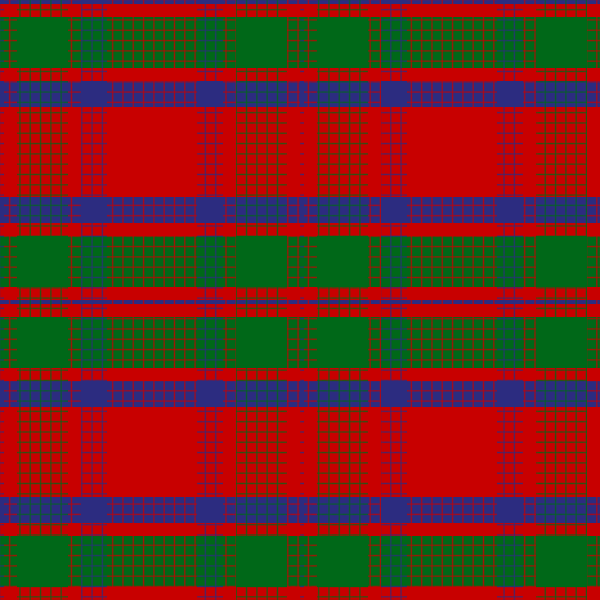 MackintoshClan tartan · Register ref. 2559
The Register records this count as closest to the sett entered in the Lyon Court Book in 1951, described by the tartan historian D.C. Stewart as one of the few ancient setts too well documented to be doubted.
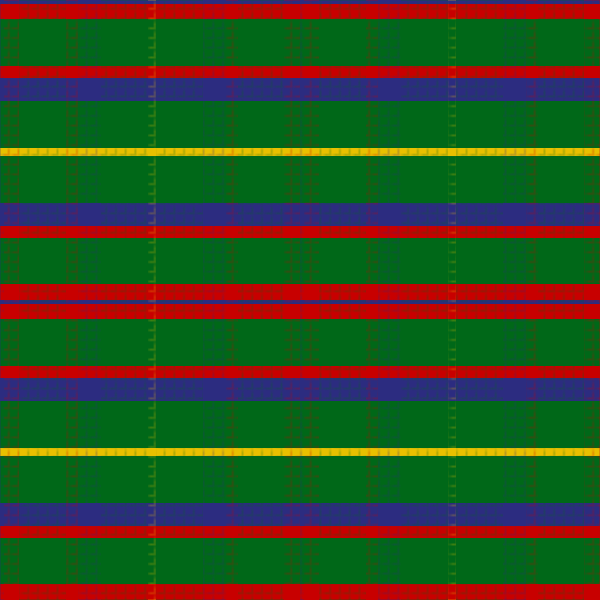 Mackintosh HuntingHunting tartan · Register ref. 2574
Recorded in the Lyon Court Book in relation to its narrowest stripe, and later published with slightly different proportions in D.C. Stewart's Setts of the Scottish Tartans.
Get the kilt
When you order a kilt, ask for the tartan by its full name — for example “Mackintosh” — and say which colourway you want. “Modern” is dark and strong, “ancient” is lighter, “weathered” is muted. The sett is the same in each.
We are choosing retailers we trust and will list them here soon.
Wear the colours
Our own Mackintosh range is on its way: the name, the tartan and the motto on a heavyweight tee, a hoodie and a mug. About the shop.
Lands and seats
- Moy Hall. Near Inverness, seat of the Mackintosh chiefs since at least the fourteenth century. The present house, built in the 1950s, is the third on the site.
Surnames
The clan name and its spellings
- Mackintosh
- McIntosh
- Tosh
- Toshach
Names associated with Clan Mackintosh
- MacAndrew
- Clark
- Dallas
- Niven
- Ritchie
- Shaw
- Shaw: Clan Shaw is itself a member of the Clan Chattan confederation, tracing descent from the same founding figure claimed by Mackintosh tradition.
“Associated” means the name appears in published sept lists for this clan. It does not prove descent, and many names are linked to more than one clan. Where your family lived is often the better clue.
Questions people ask
What is the Mackintosh tartan?
The main Mackintosh tartan is a red, green and blue sett recorded in the Scottish Register of Tartans as closest to the version entered in the Lyon Court Book in 1951. A separate Mackintosh Hunting tartan, in red, yellow, green and blue, is also registered.
What is the Mackintosh motto and crest?
The motto, in Scots, is 'Touch not the cat bot a glove' — do not touch the wildcat without a glove on. The crest badge shows a wildcat leaping, facing the viewer, within a strap and buckle.
What was the Rout of Moy?
In February 1746, while Anne Mackintosh was sheltering Charles Edward Stuart at Moy Hall, a government force marched to capture him. A small number of her men fired muskets and shouted several clans' war cries in the dark, convincing the much larger government force it faced the main Jacobite army, and it withdrew. The episode let the Prince escape.
What is the Clan Chattan confederation?
Clan Chattan was a federation of Highland kindreds, including the Macphersons, Davidsons, MacGillivrays and others, bound together for mutual protection. The Mackintosh chief led the confederation from 1291 until the Mackintosh and Clan Chattan chiefships were formally separated by the Lord Lyon in 1938.
Sources
- Clan Mackintosh — Clan Chattan Association
- Septs — Clan Mackintosh of North America
- The Battle of Invernahavon — Clan Cameron Association
- The Rout of Moy — LearnGaelic.scot
- Standing Council of Scottish Chiefs — clanchiefs.org.uk
- Scottish Register of Tartans: MacKintosh — tartanregister.gov.uk
- Scottish Register of Tartans: MacKintosh Hunting — tartanregister.gov.uk
Clan histories are contested and sources disagree. If you can correct something here with a source, write to hello@tartanflag.com. Last updated 18 September 2026.