Clan MacLean
A West Highland clan centred on the Isle of Mull. The chiefs, the Macleans of Duart, lost their castle in 1691 and bought it back in the early twentieth century.
History
The Macleans take their name from Gillean of the Battle Axe, a warrior placed by most accounts in the thirteenth century. He is said to have fought against the Norse at Largs in 1263. Very little about him can be documented. He is best treated as a name-father rather than a recorded figure.
Firmer ground comes a century later with two brothers, Lachlan Lubanach and Hector Reaganach, who were established on Mull in the fourteenth century. Lachlan married a daughter of the Lord of the Isles. Duart Castle's own history says the papal dispensation for that marriage, dated 1367, is the first record of Macleans at Duart, and that the lands which came with the bride gave the family much of Mull. Lachlan is credited with building the keep. In time branches grew up at Lochbuie, Ardgour, Coll, Torloisk and elsewhere.
As leading vassals of the Lords of the Isles, the Macleans fought at Harlaw in 1411. Their chief, Red Hector of the Battles, met Sir Alexander Irvine of Drum in single combat and both were killed. The clan was again with the Lord of the Isles at the sea fight of Bloody Bay in the early 1480s. In the sixteenth century the great rivalry was with the Campbells. One old story tells of a chief, Lachlan Cattanach, who left his Campbell wife on a tidal rock to drown. She was rescued, the story goes, and he was killed in Edinburgh by her brother, by most accounts in 1523.
The Macleans were steady royalists. Sir Lachlan received a baronetcy from Charles I in 1631. At Inverkeithing on 20 July 1651 Sir Hector Maclean was killed along with a great many of his men. Tradition says his clansmen stepped forward one after another to shield him, each crying 'Another for Hector'. Loyalty was costly. The Earl of Argyll seized Duart in 1674. Sir John Maclean recovered it briefly in 1681. The clan fought for the Jacobites at Killiecrankie in 1689, and in 1691 Sir John had to surrender the castle for good. It fell into ruin.
Macleans came out again in 1745 and fought at Culloden under Maclean of Drimnin, who was killed there. It was the clan's last campaign.
The story has an unusual ending. Sir Fitzroy Maclean, the 26th chief, bought back the ruin of Duart and set about rebuilding it. The castle's own account dates the purchase to 1910; other sources give 1911 or 1912. Duart has been the chief's home and the gathering place of the clan ever since.
Clan MacLean tartans
Names and reference numbers follow the Scottish Register of Tartans. Mills sell most setts in modern, ancient and weathered colourways. The pattern is the same; only the shades change.
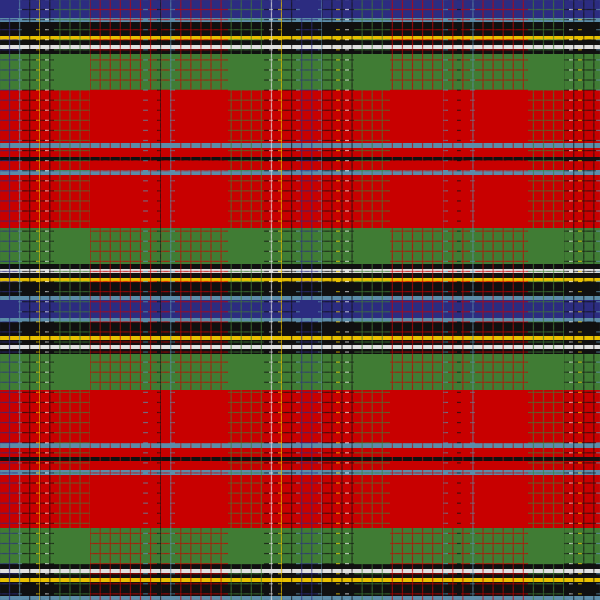 MacLean of DuartClan tartan · Register ref. 2610
The red Maclean sett with two shades of blue. The Register notes a sample in the Cockburn Collection of about 1810 to 1815, and that W. and A. Smith in 1850 called the two-blue version the oldest pattern they could find. Versions with a single blue were woven, they said, merely to save trouble.
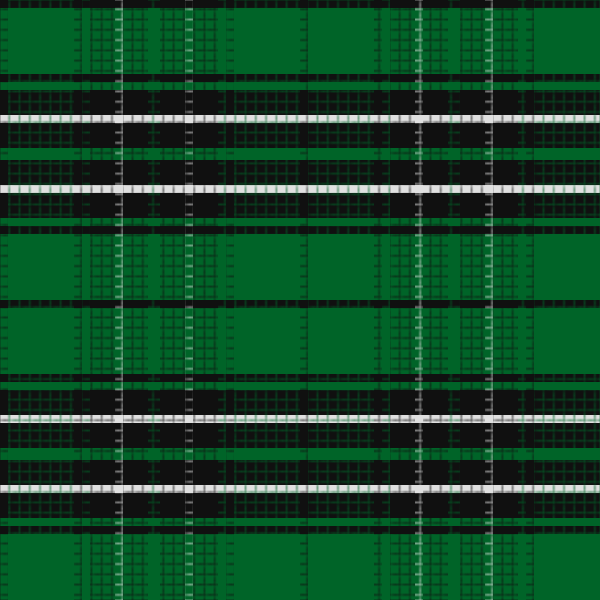 MacLean of Duart HuntingHunting tartan · Register ref. 2617
A green sett with black and a fine white line, from the Vestiarium Scoticum of 1842. A 1587 charter asking for cloth of white, black and green is sometimes cited as its origin, but the Register records the tartan historian Jamie Scarlett's view that there is no evidence for that claim.
Get the kilt
When you order a kilt, ask for the tartan by its full name — for example “MacLean of Duart” — and say which colourway you want. “Modern” is dark and strong, “ancient” is lighter, “weathered” is muted. The sett is the same in each.
We are choosing retailers we trust and will list them here soon.
Wear the colours
Our own MacLean range is on its way: the name, the tartan and the motto on a heavyweight tee, a hoodie and a mug. About the shop.
Lands and seats
- Duart Castle. On the Isle of Mull. Held by the chiefs from the fourteenth century, lost in 1691, and bought back and restored by the 26th chief in the early 1910s.
Surnames
The clan name and its spellings
- MacLean
- Maclean
- McLean
Names associated with Clan MacLean
- Lean
- Beath
- Beaton
- Black
- Bowie
- MacBeath
- MacBeth
- Macilduy
- MacLergain
- MacRankin
- Rankin
- MacVeagh
- MacVey
- MacCormick
- MacFadyen
- MacFadzean
- MacGilvra
- Macilvora
- Lean: Listed as a sept of Duart.
- Beath: Listed as a sept of Duart.
- Beaton: Listed as a sept of Duart. Also appears in MacLeod sept lists.
- Black: Listed as a sept of Duart. A common name also linked to other clans, including MacGregor.
- Bowie: Listed as a sept of Duart. Also recorded as a MacGregor alias.
- MacBeath: Listed as a sept of Duart.
- MacBeth: Listed as a sept of Duart.
- Macilduy: Listed as a sept of Duart. Also appears in MacGregor lists.
- MacLergain: Listed as a sept of Duart.
- MacRankin: Listed as a sept of Duart.
- Rankin: Listed as a sept of Duart.
- MacVeagh: Listed as a sept of Duart.
- MacVey: Listed as a sept of Duart.
- MacCormick: Listed as a sept of Maclean of Lochbuie.
- MacFadyen: Listed as a sept of Maclean of Lochbuie.
- MacFadzean: Listed as a sept of Maclean of Lochbuie.
- MacGilvra: Listed as a sept of Maclean of Lochbuie.
- Macilvora: Listed as a sept of Maclean of Lochbuie.
“Associated” means the name appears in published sept lists for this clan. It does not prove descent, and many names are linked to more than one clan. Where your family lived is often the better clue.
Questions people ask
What is the MacLean tartan?
The main sett is MacLean of Duart, a red tartan with green, black, white, yellow and two shades of blue, recorded in collections from about 1810 onwards. There is also a green MacLean of Duart hunting tartan, first published in 1842.
What is the MacLean clan motto?
The chief's motto is 'Virtue mine honour'. The crest is a battlemented tower, taken to stand for Duart Castle. The clan's Gaelic war cry is 'Bàs no Beatha', usually given as 'Death or life'.
Which surnames are associated with Clan MacLean?
Older sept lists give Beaton, Black, Lean, MacBeth, MacVey and Rankin with Maclean of Duart, and MacCormick, MacFadyen and MacGilvra with Maclean of Lochbuie. Several of these names are also linked to other clans.
Where is Clan MacLean from?
From the Isle of Mull and the neighbouring mainland and islands, including Morvern, Ardgour and Coll. Duart Castle, on a headland at the east end of Mull, is the chief's seat.
Sources
- Members — The Standing Council of Scottish Chiefs
- History — Duart Castle
- Arms of the Chief — Maclean History Project (macleanhistory.org)
- The Macleans — Electric Scotland
- Clan Maclean — Wikipedia (supplementary check)
- MacLean of Duart #6 (ref 2610) — The Scottish Register of Tartans
- MacLean of Duart Hunting (ref 2617) — The Scottish Register of Tartans
Clan histories are contested and sources disagree. If you can correct something here with a source, write to hello@tartanflag.com. Last updated 17 September 2026.