Clan MacLeod
Clann Mhic Leòid
A Hebridean clan of Norse-Gaelic origin, in two great branches: Harris and Dunvegan, and Lewis. Dunvegan Castle on Skye has been the chiefs' home for centuries.
History
The MacLeods take their name from Leod, who lived on the western seaboard in the thirteenth century. The clan societies describe him as a Norseman, born around 1200. Older histories go further and make him a son of Olaf the Black, King of Man. That descent was already doubted in the nineteenth century by the historian W. F. Skene, and later genealogical work points to a more distant link, possibly through a female line. The honest position is that Leod's parentage is not known for certain.
Two lines descend from him. Sìol Tormoid, the seed of Tormod, became the MacLeods of Harris and Dunvegan. Sìol Torcaill, the seed of Torquil, became the MacLeods of Lewis, with later branches in Assynt and on Raasay. Tradition makes Tormod and Torquil brothers. The clan societies now describe Torquil as a great-grandson of Leod. Dunvegan, on a rock above a sea loch in north-west Skye, is described by the clan societies as the chiefs' seat since Leod's time.
In the Middle Ages both branches followed the Lords of the Isles. MacLeods were with Donald of the Isles on the campaign that ended at Harlaw in 1411. A chief of the Dunvegan line was killed at the sea battle of Bloody Bay off Mull, which the sources date variously to the early 1480s. Alasdair Crotach, the eighth chief, built St Clement's Church at Rodel in Harris in the early 1500s. He commissioned his own tomb there in 1528 and was laid in it after his death in 1547. It is now in the care of Historic Environment Scotland.
Feuding with the MacDonalds ran through the sixteenth century. Tradition holds that in May 1578 MacDonalds from Uist burned the church at Trumpan with the congregation inside. The MacLeod revenge is remembered as the Battle of the Spoiling of the Dyke. The Lewis branch fared worst in this period. Its main line failed and the island passed to the Mackenzies in the early seventeenth century. At Dunvegan, Sir Rory Mor was knighted by James VI and is remembered in the great drinking horn that bears his name.
The clan fought for Charles II at Worcester in 1651 and its losses were severe. One old account says the other clans agreed the MacLeods should be spared further fighting until they had recovered. In 1745 the chief did not join Prince Charles. He raised Independent Companies for the government, although some MacLeods, notably from Raasay, fought on the Jacobite side.
Dunvegan still holds the clan's treasures: Rory Mor's Horn, the Dunvegan Cup and the Fairy Flag. The castle describes the flag as silk, probably from Syria or Rhodes, and tells three different legends of how it arrived. In the twentieth century Dame Flora MacLeod of MacLeod, who succeeded as 28th chief in 1935, instituted the first gathering of Clan MacLeod in 1956. She died in 1976, aged 98. The present chief is the 30th and succeeded in 2007.
Clan MacLeod tartans
Names and reference numbers follow the Scottish Register of Tartans. Mills sell most setts in modern, ancient and weathered colourways. The pattern is the same; only the shades change.
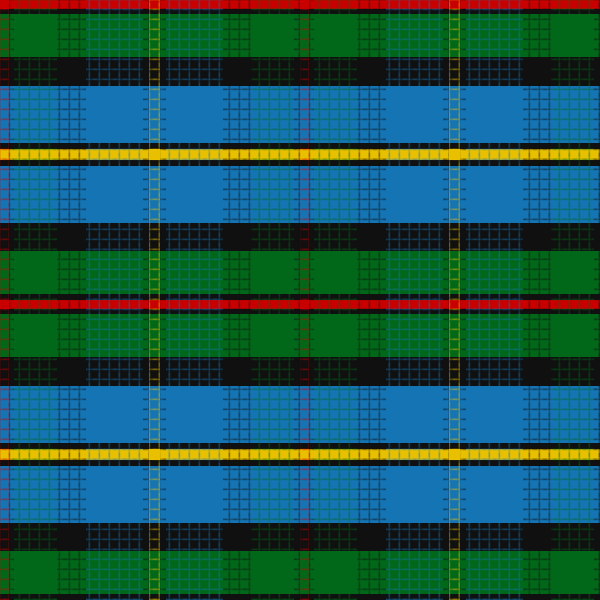 MacLeod GreenClan tartan · Register ref. 2629
The green and blue sett. The Register says it is sometimes called 'hunting'; weavers commonly sell it as MacLeod of Harris. The Register traces it to the Mackenzie-based tartan of Lord MacLeod's Highlanders, raised in 1777, and notes that it appears in Logan's collection of 1831. The Register records that the chief approved it in 1910 and that the clan society adopted it.
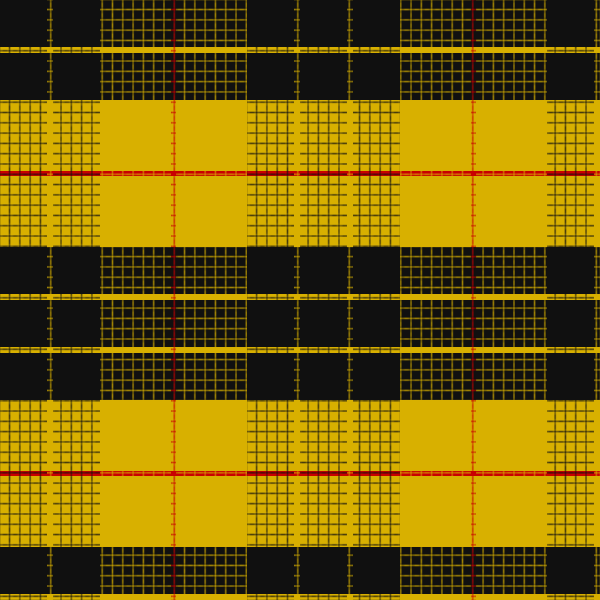 MacLeod of LewisDress tartan · Register ref. 2640
The bold yellow and black sett, also known as MacLeod dress and jokingly as 'Loud MacLeod'. It comes from the Vestiarium Scoticum of 1842, though the Register notes that a sketch of it was already in MacLeod hands by 1829.
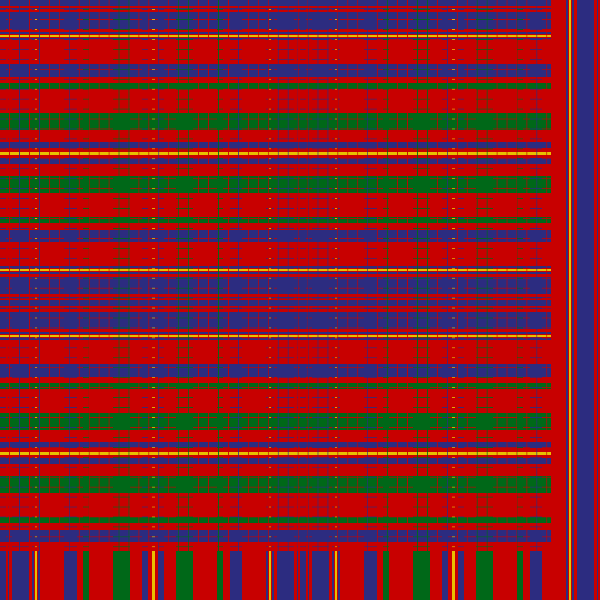 MacLeod RedOther sett · Register ref. 2643
Based on the tartan in Allan Ramsay's 1747 portrait of the 22nd chief, with a yellow stripe added to match the other MacLeod setts. The Register records that a clan parliament adopted it as the red MacLeod in 1982.
Get the kilt
When you order a kilt, ask for the tartan by its full name — for example “MacLeod Green” — and say which colourway you want. “Modern” is dark and strong, “ancient” is lighter, “weathered” is muted. The sett is the same in each.
We are choosing retailers we trust and will list them here soon.
Wear the colours
Our own MacLeod range is on its way: the name, the tartan and the motto on a heavyweight tee, a hoodie and a mug. About the shop.
Lands and seats
- Dunvegan Castle. On the Isle of Skye. The clan society describes it as the chiefs' seat since the time of Leod, and the present chief divides his time between Dunvegan and London.
Surnames
The clan name and its spellings
- MacLeod
- McLeod
- Macleod
Names associated with Clan MacLeod
- Beaton
- Harold
- MacAndie
- MacAskill
- MacCaig
- MacCaskie
- MacClure
- MacCorkill
- MacCrimmon
- MacWilliam
- Allum
- Lewis
- MacAulay
- MacCabe
- Malcolmson
- Norrie
- Tolmie
- Norman
- Nicolson
- Beaton: Listed with the Harris and Dunvegan branch. Also appears in Maclean sept lists.
- Harold: Listed with the Harris and Dunvegan branch.
- MacAndie: Listed with the Harris and Dunvegan branch.
- MacAskill: The clan society lists it with Harris and Dunvegan; some older lists place it with Lewis.
- MacCaig: Listed with the Harris and Dunvegan branch.
- MacCaskie: Listed with the Harris and Dunvegan branch.
- MacClure: Listed with the Harris and Dunvegan branch.
- MacCorkill: The clan society cautions that MacCorkills from Argyll may have no MacLeod link.
- MacCrimmon: Listed with the Harris and Dunvegan branch.
- MacWilliam: Listed with the Harris and Dunvegan branch. The name is also linked to other clans.
- Allum: Listed with the Lewis branch.
- Lewis: Listed with the Lewis branch.
- MacAulay: Only the MacAulays of Lewis are linked to the MacLeods.
- MacCabe: Listed with the Lewis branch.
- Malcolmson: Listed with the Lewis branch.
- Norrie: Listed with the Lewis branch.
- Tolmie: Listed with the Lewis branch.
- Norman: Appears in older sept lists, but the clan society says modern research has found no real connection.
- Nicolson: Once counted as a Lewis sept; Clan MacNicol now has its own chief.
“Associated” means the name appears in published sept lists for this clan. It does not prove descent, and many names are linked to more than one clan. Where your family lived is often the better clue.
Questions people ask
What is the MacLeod tartan?
The clan society names the Harris and Lewis tartans as the two most common. The green and blue sett is commonly sold as MacLeod of Harris; the Register lists it as Green MacLeod, sometimes called hunting, and records the chief's approval in 1910. The yellow and black MacLeod of Lewis, or dress MacLeod, comes from the Vestiarium Scoticum of 1842.
What is the MacLeod clan motto?
The motto of MacLeod of MacLeod is 'Hold fast'. The crest is a bull's head between two flags. The Lewis and Raasay chiefs have their own mottoes.
Which surnames are associated with Clan MacLeod?
The clan society lists names such as Beaton, MacAskill, MacClure and MacCrimmon with the Harris and Dunvegan branch, and Lewis, MacAulay of Lewis, Malcolmson and Tolmie with the Lewis branch. It stresses that sharing a sept name does not prove a family link.
Where is Clan MacLeod from?
From Skye and the Outer Hebrides. The Harris and Dunvegan branch held Dunvegan on Skye and the island of Harris. The Lewis branch held Lewis, with offshoots on Raasay and in Assynt.
Sources
- Clan History — Associated Clan MacLeod Societies (clanmacleod.org)
- Septs — Associated Clan MacLeod Societies (clanmacleod.org)
- Arms and crests — Associated Clan MacLeod Societies (clanmacleod.org)
- Members — The Standing Council of Scottish Chiefs
- St Clement's Church: History — Historic Environment Scotland
- The Fairy Flag — Dunvegan Castle & Gardens
- The Macleods — Electric Scotland
- Clan MacLeod — Wikipedia (supplementary check)
- Tartans — Associated Clan MacLeod Societies (clanmacleod.org)
- Symbols — Associated Clan MacLeod Societies (clanmacleod.org)
- Chief Hugh MacLeod of MacLeod — Associated Clan MacLeod Societies (clanmacleod.org)
- Trumpan Church — Undiscovered Scotland
- MacLeod of Harris tartan — CLAN by Scotweb (clan.com)
- Green MacLeod (ref 2629) — The Scottish Register of Tartans
- MacLeod of Lewis (Vestiarium Scoticum) (ref 2640) — The Scottish Register of Tartans
- MacLeod Red (ref 2643) — The Scottish Register of Tartans
Clan histories are contested and sources disagree. If you can correct something here with a source, write to hello@tartanflag.com. Last updated 17 September 2026.