Clan Macnab
Clann an Aba
Macnab is a small Highland clan from Glen Dochart and the shores of Loch Tay, its name and chiefly line both tracing back to the lay abbots who once held that glen for the old Celtic church.
History
Macnab takes its name from the Gaelic Mac an Aba, 'son of the abbot'. Tradition names Abraruadh, lay abbot of the old church lands at Glen Dochart, as the clan's founder, and makes him one of the sons of Kenneth MacAlpin, the king credited with bringing Scotland's kingdoms together under one crown. Nothing this early can be checked against a document, and the clan's own historians treat it as tradition rather than fact, but it explains both the surname and the family's long association with the church lands around Strathfillan. Chiefs of the name are recorded from 1124.
The wars of independence hit the clan hard. In 1306 the Macnab chief sided with the MacDougalls of Lorn against Robert the Bruce, and after Bruce's victory at Bannockburn in 1314 the family paid for it, with their charters destroyed and their lands forfeited. Recovery took a generation. In 1336 David II granted a fresh charter, for the barony of Bovain in Glen Dochart, to Gilbert Macnab, who is reckoned the first chief whose position rests on solid record rather than tradition alone. Across the two hundred years that followed, the family's holdings spread out from Bovain to cover the whole of Glen Dochart, reaching west to Tyndrum and east along Loch Tay to Killin.
That country brought the Macnabs into a long feud with their neighbours the Neishes of Lochearnside, which came to a head at the Battle of Glenboultachan in 1522, near St Fillans. The Neishes were all but wiped out; a small remnant held on afterwards on an island in Loch Earn, from where, clan tradition says, they went on raiding their old rivals for years before the feud was finally settled. It remains one of the best-remembered stories clan members still tell of the family's Glen Dochart days.
The Macnabs backed the Crown in the civil wars of the 1640s, fighting for the Marquess of Montrose and the Royalist cause, including at the victory at Kilsyth in 1645. A century on, during the 1745 rising, the clan was less united: the 15th Chief, John Macnab, held a commission in the government's Black Watch and was present at Prestonpans, while other Macnab families, among them those of Inshewan and Acharne, came out for the Stuarts. Kinnell House, built near Killin around 1580, had by then become the chiefs' seat, a role it held from 1654 into the twentieth century.
The clan's estates were sold off piecemeal over the following two centuries, and Kinnell itself passed out of Macnab hands before returning to the chief in the twentieth century. James Charles Macnab succeeded his great-uncle as 23rd Chief in 1970. He kept up a busy round of visits to clan gatherings both in Scotland and abroad over the following decades, and the society's overseas membership grew substantially as a result; death duties then forced him to sell Kinnell House and most of the surrounding estate in 1978. His son, Jamie Macnab of Macnab, became 24th Chief on his father's death in 2013 and has carried that work forward, reviving the Clan Macnab Society his father had hoped to see re-established.
Clan Macnab tartans
Names and reference numbers follow the Scottish Register of Tartans. Mills sell most setts in modern, ancient and weathered colourways. The pattern is the same; only the shades change.
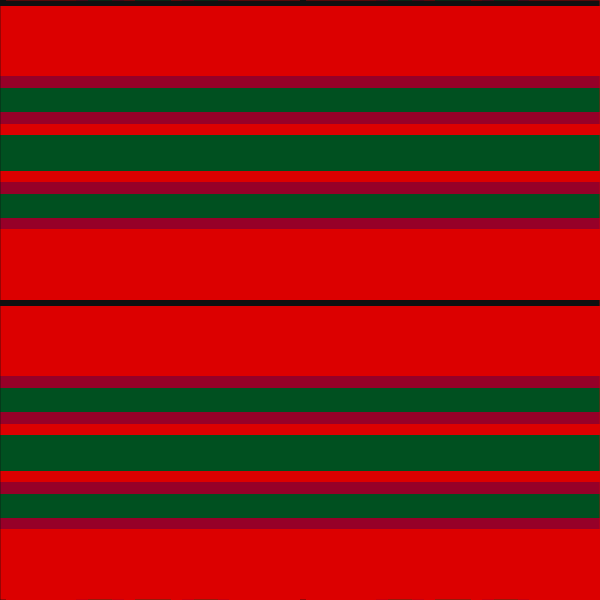 MacNabClan tartan · Register ref. 2666
This sett was published in the Vestiarium Scoticum, which appeared in instalments between 1829 and 1842. Its authors, the self-styled Sobieski Stuart brothers, claimed royal Stuart descent to lend the book authority, but the work is now generally treated as a Victorian invention rather than a genuine record of old clan tartans, so we can't call this pattern ancient.
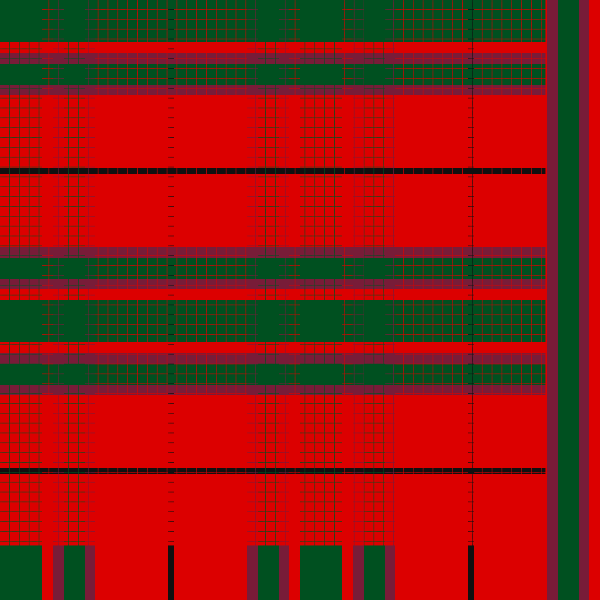 MacNab, CrimsonOther sett · Register ref. 2668
A colour variant of the same Vestiarium Scoticum design, recorded in the Register with a plain red standing in for the more purplish shade used elsewhere in the sett. It shares the same disputed 19th-century origin as the standard Macnab tartan above.
Get the kilt
When you order a kilt, ask for the tartan by its full name — for example “MacNab” — and say which colourway you want. “Modern” is dark and strong, “ancient” is lighter, “weathered” is muted. The sett is the same in each.
We are choosing retailers we trust and will list them here soon.
Wear the colours
Our own Macnab range is on its way: the name, the tartan and the motto on a heavyweight tee, a hoodie and a mug. About the shop.
Lands and seats
- Bovain. In Glen Dochart. Named as the barony granted by charter to Gilbert Macnab in 1336, the foundation of the documented chiefly line.
- Kinnell House. Near Killin. Built around 1580 and the seat of the Macnab chiefs from 1654; sold in 1978 by the 23rd Chief to meet death duties.
Surnames
The clan name and its spellings
- MacNab
- McNab
- MacNabb
Names associated with Clan Macnab
- Abbott
- Abbotson
- Dewar
- Macandeoir
- Gilfillan
- Gillan
- MacNair
- Cleland
- MacLellan
- Abbott: Echoes the clan's own Gaelic name, Mac an Aba, 'son of the abbot'.
- Abbotson: Another English rendering of 'son of the abbot'.
- Dewar: From the Gaelic deòradh, a hereditary keeper of a saint's relic; Dewar families held this role at Glen Dochart and are also linked to other Perthshire clans.
- Macandeoir: An older Gaelic form meaning 'son of the dewar'.
- Gillan: A shortened form of Gilfillan.
- MacLellan: MacLellan is also an established clan name in its own right in Galloway; here it is listed as an associated Macnab name.
“Associated” means the name appears in published sept lists for this clan. It does not prove descent, and many names are linked to more than one clan. Where your family lived is often the better clue.
Questions people ask
What is the Macnab tartan?
The Macnab tartan comes from the Vestiarium Scoticum, a book published in instalments between 1829 and 1842 that claimed to record ancient clan tartans but is now generally regarded as a Victorian invention. No earlier Macnab tartan is known, so the pattern is best treated as part of that 19th-century wave of clan tartan-making rather than an old Highland design.
Does Clan Macnab have a chief?
Yes. The current chief is Jamie Macnab of Macnab, 24th Chief of Clan Macnab, who succeeded his father, James Charles Macnab, in 2013.
What does the Macnab motto mean?
The motto is Timor Omnis Abesto, Latin for 'let fear be far from all'. It appears on a scroll below the crest, a bearded man's head shown facing forward.
What surnames are linked to Clan Macnab?
Names traditionally associated with Macnab include Abbott and Abbotson, which echo the clan's own Gaelic name meaning 'son of the abbot', along with Dewar, Macandeoir, Gilfillan, Gillan, MacNair and Cleland. McNab and MacNabb are simply spelling variants of the clan name itself.
Sources
- MacNab #3 tartan (ref. 2666) — Scottish Register of Tartans
- MacNab (Crimson) tartan (ref. 2668) — Scottish Register of Tartans
- MacNab — COSCA - Council of Scottish Clans & Associations
- Brief history of Clan Macnab — Clan Macnab Society
- Jamie Macnab of Macnab Story — Clan Macnab Society
- The Notorious Chief — Clan Macnab Society
- Clan Macnab Crest and Clan Macnab Motto — Clan Macnab Society
- The Plant Badge of Clan Macnab — Clan Macnab Society
- Obituary: James Macnab of Macnab, Chief who did much to revive Clan Macnab's fortunes worldwide — The Scotsman
- Killin, Kinnell House including walled garden and ancillary buildings (LB8283) — Historic Environment Scotland / Trove
Clan histories are contested and sources disagree. If you can correct something here with a source, write to hello@tartanflag.com. Last updated 27 September 2026.