Clan Ramsay
A Lowland clan with Midlothian roots, tied to Dalhousie Castle for some eight centuries. Its chief is the Earl of Dalhousie, whose seat is now Brechin Castle in Angus.
History
The Ramsays belong to the Lowlands, and the family's story starts just south of Edinburgh. Tradition holds that Simon de Ramsay travelled north during the reign of David I and received land in Lothian. Most writers take the surname to be a place name. The first firm records come later: a William de Ramsay of Dalhousie is listed among the king's counsellors in the 1250s, and another man of that name turns up in 1296.
1296 was a bleak year for Scotland. William's seal appears on the Ragman Roll, which recorded the Scottish landholders forced to swear fealty to Edward I of England. By the next generation the Ramsays had switched sides. Ramsay of Dalhousie is counted among those who put their names to the Declaration of Arbroath in 1320, the letter to the Pope arguing Scotland's right to independence under Robert the Bruce.
The family then grew into several branches, among them Dalhousie, Auchterhouse, Bamff, Forfar and Clatto, with Dalhousie Castle in the parish of Cockpen as the main centre. Accounts disagree about how the branches were related, and the early genealogies are better read as tradition than as proven descent. Some parts of the castle are said to be very old, and it was altered and enlarged many times.
Real national standing came in the seventeenth century. William Ramsay, who had inherited from his father in 1629, was granted the titles Earl of Dalhousie and Lord Ramsay of Keringtoun by a patent of 29 June 1633, the year Charles I was crowned in Scotland. The earldom has remained with the chief's line since then, and it lifted the family above what its medieval landholding alone had achieved. Angus came into the picture later. Through the Maule inheritance, the Panmure estates around Brechin passed to the Dalhousie line in 1782, and in the nineteenth century Brechin Castle became the Earls' principal home.
The Ramsays held Dalhousie Castle until 1977, and it now operates as a hotel. The present Earl, who is chief of Clan Ramsay, lives at Brechin Castle. The Register of Tartans adds a wider note: Ramsay was one of the names adopted by MacGregors while their own was proscribed, which is one reason the early Ramsay tartan owes something to a MacGregor sett.
Clan Ramsay tartans
Names and reference numbers follow the Scottish Register of Tartans. Mills sell most setts in modern, ancient and weathered colourways. The pattern is the same; only the shades change.
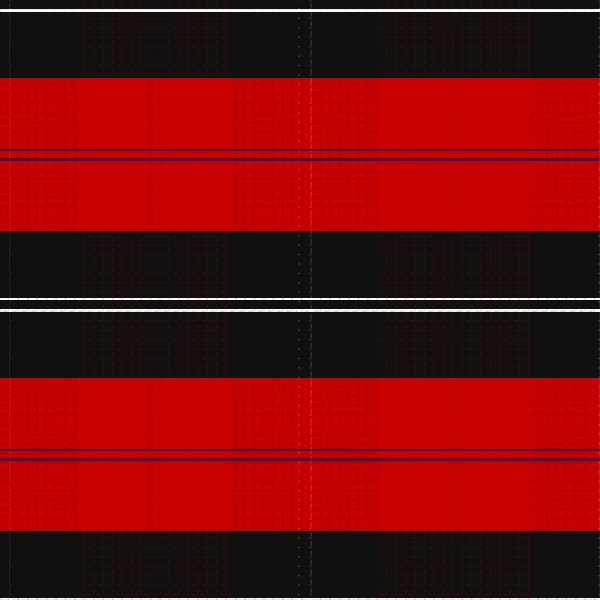 Ramsay (Red)Clan tartan · Register ref. 3453
The Register dates this sett to 1842 and notes that it may be much older. It also records that an early MacGregor sett lies behind it, a link that fits with Ramsay being one of the names MacGregors took when their own was banned.
 Ramsay Blue HuntingHunting tartan · Register ref. 3454
Recognised as the hunting sett, with blue standing in for the red of the main tartan. The Register traces the sample to a mid-twentieth-century collection and gives a date of 1950, and quotes a view that blue dyes were widely used in the Lowlands.
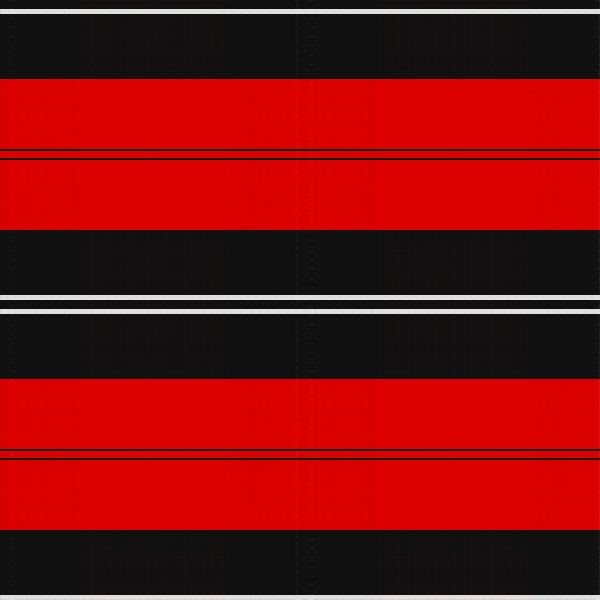 Ramsay of DalhousieClan tartan · Register ref. 3455
A variation on the Vestiarium sett, with black where that version has crimson. The Register gives no date, and notes that an earlier writer simply called it Ramsay.
Get the kilt
When you order a kilt, ask for the tartan by its full name — for example “Ramsay (Red)” — and say which colourway you want. “Modern” is dark and strong, “ancient” is lighter, “weathered” is muted. The sett is the same in each.
We are choosing retailers we trust and will list them here soon.
Wear the colours
Our own Ramsay range is on its way: the name, the tartan and the motto on a heavyweight tee, a hoodie and a mug. About the shop.
Lands and seats
- Dalhousie Castle. The old Ramsay stronghold near Bonnyrigg in Midlothian, held by the family for around eight centuries until its sale in 1977. It is now a hotel.
- Brechin Castle. Home of the Earl of Dalhousie in Angus. It came to the family with the Panmure estates, which passed to the Dalhousie line in 1782, and became the principal Ramsay residence in the nineteenth century.
Surnames
The clan name and its spellings
- Ramsay
- Ramsey
- Rumsey
Names associated with Clan Ramsay
- Dalhousie
- Maule
- Brechin
- Brecheen
- Dalhousie: Taken from the Ramsay title and castle.
- Maule: Also the name of a separate family; listed in clan society sept lists.
- Brechin: A place name, also borne by families with no Ramsay link.
- Brecheen: A variant form of Brechin.
“Associated” means the name appears in published sept lists for this clan. It does not prove descent, and many names are linked to more than one clan. Where your family lived is often the better clue.
Questions people ask
What is the Ramsay tartan?
The Scottish Register of Tartans lists several Ramsay setts. We feature Ramsay (Red) (ref. 3453), dated 1842, Ramsay Blue Hunting (ref. 3454), dated 1950, and Ramsay of Dalhousie (ref. 3455), which has no recorded date.
What is the Ramsay clan motto?
The motto is Ora et labora, Latin for 'pray and work'. The crest is a unicorn's head and the plant badge is the blue harebell.
Who is the chief of Clan Ramsay?
The chief is the Earl of Dalhousie. The earldom was created in 1633, and the family seat is now Brechin Castle in Angus.
Where do the Ramsays come from?
The clan's roots are in Lothian, around Dalhousie Castle near Bonnyrigg in Midlothian. The family later became closely linked with Angus and Brechin.
Sources
- Ramsay (Red) tartan (ref. 3453) — Scottish Register of Tartans
- Ramsay Blue Hunting tartan (ref. 3454) — Scottish Register of Tartans
- Ramsay of Dalhousie tartan (ref. 3455) — Scottish Register of Tartans
- Clan Ramsay About Us — Clan Ramsay
- Dalhousie, Earl of (S, 1633) — Cracroft's Peerage
- Dalhousie Castle — Historic Environment Scotland (Trove)
- The Ramsay Family: 850 Years of History — Dalhousie Castle
- Ramsay — VisitScotland
- History — Dalhousie Estates
- Clan Ramsay history — Clan Ramsay Europe
Clan histories are contested and sources disagree. If you can correct something here with a source, write to hello@tartanflag.com. Last updated 2 October 2026.