Clan Scott
One of the great riding families of the Scottish Borders, based in Teviotdale and Ettrick Forest. The chief is the Duke of Buccleuch and Queensberry.
History
The earliest certain Scott is Uchtred 'filius Scoti', son of the Scot, who witnessed charters in the reign of David I, around 1120. Little more is known of him. Later pedigrees join him to the Scotts of Buccleuch. The links in between are not all documented.
Buccleuch itself comes into the story with Sir Richard Scott, around 1300. The family histories say he gained Murthockston by marrying its heiress, kept Ettrick Forest for the crown as its ranger, and made his home at Buccleuch. The same histories put his son, Sir Michael, on the field at Halidon Hill in 1333 and have him die at Durham in 1346. The move that mattered most came in the next century. Half of Branxholme, near Hawick, came to the Scotts in 1420. By 1463 they held it as a free barony, and the yearly rent was a single red rose. Branxholme stayed the family's base after that, and by about 1500 a laird of Buccleuch was reckoned able to raise a thousand mounted men.
Those riders mattered, because this was reiver country and the Scotts were one of its strongest names. They also played for higher stakes. In the summer of 1526 Sir Walter Scott of Branxholme and Buccleuch met the Earl of Angus near Melrose and tried to take the young James V from him by force. The attempt failed. Among the dead was Kerr of Cessford, and the Kerrs did not forget: in 1552 they cut Sir Walter down in Edinburgh's High Street. The exploit the Borders remembered best belongs to a later Walter Scott, known as 'Bold Buccleuch'. In 1596 he got into Carlisle Castle and brought out the captured reiver Kinmont Willie Armstrong. Word of it reached Elizabeth I.
The Union of the Crowns in 1603 ended the old Border life, and the chiefs turned from riders into noblemen. The lordship of Scott of Buccleuch was created in 1606 and the earldom in 1619. The second earl supported the Covenant. He died in 1651, leaving only young daughters. The younger, Anne, was married in 1663 to the Duke of Monmouth, the eldest illegitimate son of Charles II, and the pair were created Duke and Duchess of Buccleuch. Monmouth was beheaded after his rebellion in 1685. Anne held her title in her own right, and it passed to her grandson.
Later marriages brought the Montagu estates in England and, in 1810, the dukedom of Queensberry with Drumlanrig Castle. The family name became Montagu Douglas Scott, and in 1975 the duke was recognised as Chief of the Name and Arms of Scott. Bowhill, near Selkirk, is the Scott house among the family's seats.
The best-known bearer of the name was not a chief. Sir Walter Scott (1771-1832), poet and novelist, came from the Harden branch and built Abbotsford on the Tweed. He was no believer in a Scott tartan. When one was described to him in 1829, from a manuscript belonging to the Sobieski Stuart brothers, he rejected the idea firmly. It is now the most widely worn Scott sett.
Clan Scott tartans
Names and reference numbers follow the Scottish Register of Tartans. Mills sell most setts in modern, ancient and weathered colourways. The pattern is the same; only the shades change.
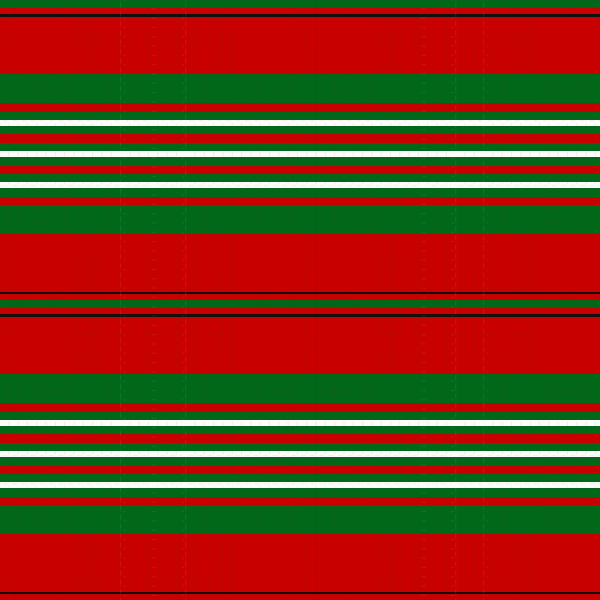 ScottClan tartan · Register ref. 3688
The red Scott, and the most popular Scott tartan today. The Register traces it to 1829, when Sir Thomas Dick Lauder told Sir Walter Scott he had seen it in a manuscript prepared for the Sobieski Stuart brothers. Scott rejected the idea firmly. The sett has been noted to resemble the MacGregor tartan of 1819.
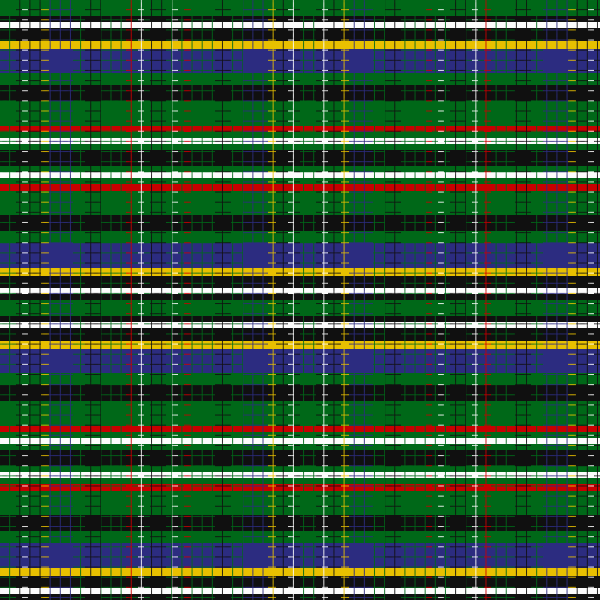 Scott GreenOther sett · Register ref. 3692
Usually sold as Green Scott. A dark sett of green, blue and black with red, yellow and white lines, taken from the MacKinlay strip in the Marcus K. Milne collection in Aberdeen. It is generally available from weavers.
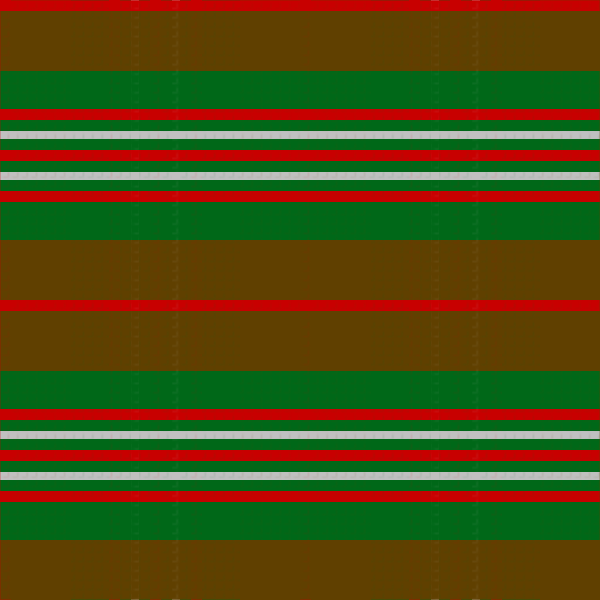 Scott HuntingHunting tartan · Register ref. 3700
A brown and green hunting sett with red and pale grey lines. The Register records that it was first seen in W. & A. K. Johnston's publication of 1906.
 Scott Black and WhiteOther sett · Register ref. 3691
A black and white check from the Morgan collection once held by the Scottish Tartans Society. The Register also holds a different black and white sett published by Smibert in 1850, who said Sir Walter Scott had it made for his own use in 1822.
Get the kilt
When you order a kilt, ask for the tartan by its full name — for example “Scott” — and say which colourway you want. “Modern” is dark and strong, “ancient” is lighter, “weathered” is muted. The sett is the same in each.
We are choosing retailers we trust and will list them here soon.
Wear the colours
Our own Scott range is on its way: the name, the tartan and the motto on a heavyweight tee, a hoodie and a mug. About the shop.
Lands and seats
- Bowhill House. The Duke of Buccleuch's Borders home, near Selkirk.
- Branxholme Castle. Near Hawick; the Scotts' headquarters in the reiving centuries, a free barony from 1463.
- Dalkeith Palace. Historic Buccleuch seat in Midlothian, still owned by the family.
- Drumlanrig Castle. Dumfriesshire seat that came with the Queensberry inheritance in 1810.
Surnames
The clan name and its spellings
- Scott
- Scot
- Scotte
- Scotus
Names associated with Clan Scott
- Buccleuch
- Geddes
- Laidlaw
- Langlands
- Buccleuch: From the chief's territorial title.
- Geddes: Listed as a sept in some published lists; Geddes is a surname with its own history, so a link to the Scotts should not be assumed.
“Associated” means the name appears in published sept lists for this clan. It does not prove descent, and many names are linked to more than one clan. Where your family lived is often the better clue.
Questions people ask
What is the Scott tartan?
The main Scott tartan is the red Scott, a red sett with green bands and white lines that dates from about 1829. Green Scott, a hunting sett in brown and green, and a black and white check are also recorded for the name.
What is the Scott clan motto?
The chief's motto is 'Amo', Latin for 'I love'. The crest is a stag.
Which surnames are associated with Clan Scott?
Published sept lists give Buccleuch, Geddes, Laidlaw and Langlands. These are associated names, and Geddes in particular is linked with other families too.
Where does Clan Scott come from?
From the central Scottish Borders: Ettrick Forest, Teviotdale around Hawick, and the dales running down to the English border. Buccleuch, Branxholme and Harden are all in that country.
Sources
- The Scotts of Buccleuch — Bowhill House (Buccleuch Living Heritage Trust)
- Scott of Buccleuch: an ancient Scottish clan coupled with an illegitimate royal line — Dukes and Princes
- Clan Scott — Wikipedia
- Tartan details: Scott — The Scottish Register of Tartans
- Tartan details: Scott (Green) — The Scottish Register of Tartans
- Tartan details: Scott Hunting — The Scottish Register of Tartans
- Tartan details: Scott (Black and White) — The Scottish Register of Tartans
- Tartan details: Scott (Sir Walter Scott) (Personal) — The Scottish Register of Tartans
Clan histories are contested and sources disagree. If you can correct something here with a source, write to hello@tartanflag.com. Last updated 17 September 2026.