Clan Sinclair
A family of Norman origin that rose at Roslin near Edinburgh, became Earls of Orkney and then of Caithness, and built Rosslyn Chapel. The chief is the Earl of Caithness.
History
Sinclair is a Norman name, from Saint-Clair in France; one clan account points to Saint-Clair-sur-Epte. Tradition says that a William de Saint-Clair came to Scotland in the train of Margaret, the English princess who married Malcolm III around 1070, and that he was given Roslin, south of Edinburgh. The documents begin later. A Henry de Saint-Clair had a charter of Herdmanston in Haddingtonshire in the early 1160s, and in 1280 Sir William Sinclair, sheriff of Edinburgh, received the barony of Roslin from Alexander III.
The Roslin family stood with Bruce in the Wars of Independence. Sir Henry Sinclair is said to have fought at the battle of Roslin in 1303, and the family was at Bannockburn in 1314. His son William died in Spain in 1330 beside Sir James Douglas, at Teba, while carrying Bruce's heart towards the Holy Land.
A marriage then took the family far to the north. In 1379 Henry Sinclair made good a claim through his mother to the earldom of Orkney, which he held from the King of Norway. Much has been written about a voyage he is supposed to have made to North America in 1398. No writer of his own time mentions it, and historians treat it as a modern myth. A later William, third Sinclair earl, was Chancellor of Scotland in the 1450s. He founded Rosslyn Chapel in 1446 and was made Earl of Caithness in 1455. When Orkney passed to the Scottish crown around 1470 he gave up that earldom in exchange for Ravenscraig in Fife.
In 1476 Earl William divided his lands. Caithness went to one son, Roslin to another, and the eldest became Lord Sinclair. From then on the Caithness earls were the main line. The second earl, who built Girnigoe on the cliffs north of Wick, died at Flodden in 1513 with many of his name. The third fell at Summerdale in Orkney in 1529. Their successors spent the century in feuds with the Earls of Sutherland, who besieged Girnigoe without success in 1588. In 1606 the fifth earl enlarged Girnigoe and asked Parliament to rename it Castle Sinclair.
Debt nearly ended the earldom. In 1672 the sixth earl made over his estates to his creditor, Sir John Campbell of Glenorchy. When the earl died in 1676, Campbell claimed the earldom too. George Sinclair of Keiss, the nearer heir, contested it. Campbell beat him at Altimarlach near Wick in July 1680, but in 1681 Keiss was confirmed as earl. Campbell was made Earl of Breadalbane instead. The castle is now a ruin.
Sinclairs were found on both sides of the Jacobite risings. The Master of Sinclair fought for the Jacobites at Sheriffmuir in 1715, while in 1745 the Earl of Caithness supported the government. Since 1998 the Clan Sinclair Trust has been conserving Castle Sinclair Girnigoe.
Clan Sinclair tartans
Names and reference numbers follow the Scottish Register of Tartans. Mills sell most setts in modern, ancient and weathered colourways. The pattern is the same; only the shades change.
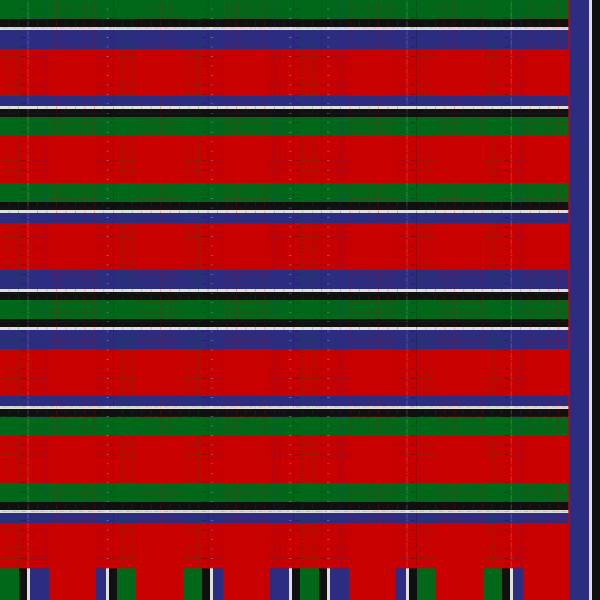 SinclairClan tartan · Register ref. 3792
The red Sinclair, with green and blue bands edged by black and white lines. The Register notes that this threadcount was recorded in the Lyon Court Books in June 1951 by the Earl of Caithness, chief of the Sinclairs. The Register's entry is dated 2002, but the count itself is older.
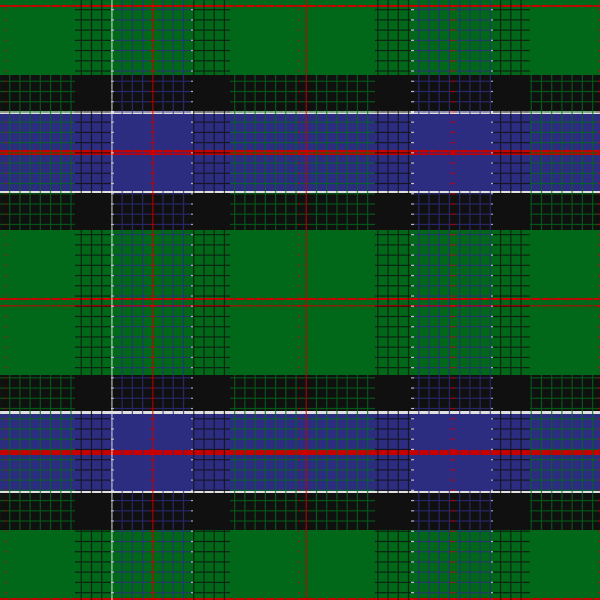 Sinclair HuntingHunting tartan · Register ref. 3797
The green hunting Sinclair, with black and blue bands and fine red and white lines, recorded from a Lochcarron swatch. The Register is sceptical of the popular story that Sinclairs wore a green tartan at Flodden in 1513, noting that no source is given for it.
 Sinclair DressDress tartan · Register ref. 3794
A blue and white dress sett with black bands and green and red lines, The Register is unsure of its origins. It says the count apparently came from the files of D. C. Dalgliesh of Selkirk in 1998, and that it may be a dancers' fancy tartan rather than a true clan or family sett.
Get the kilt
When you order a kilt, ask for the tartan by its full name — for example “Sinclair” — and say which colourway you want. “Modern” is dark and strong, “ancient” is lighter, “weathered” is muted. The sett is the same in each.
We are choosing retailers we trust and will list them here soon.
Wear the colours
Our own Sinclair range is on its way: the name, the tartan and the motto on a heavyweight tee, a hoodie and a mug. About the shop.
Lands and seats
- Castle Sinclair Girnigoe. Clifftop stronghold of the Earls of Caithness, about three miles north of Wick; now a ruin in the care of the Clan Sinclair Trust.
- Rosslyn Chapel. Founded in 1446 by William Sinclair, Earl of Orkney, at Roslin in Midlothian; still a working church.
Surnames
The clan name and its spellings
- Sinclair
- St Clair
- Saint-Clair
Names associated with Clan Sinclair
- Budge
- Caird
- Clouston
- Clyne
- Cline
- Groat
- Laird
- Linklater
- Lyall
- Mason
- Peace
- Purdie
- Purdy
- Snoddy
- Wares
“Associated” means the name appears in published sept lists for this clan. It does not prove descent, and many names are linked to more than one clan. Where your family lived is often the better clue.
Questions people ask
What is the Sinclair tartan?
The main Sinclair tartan is red, with green and blue bands and thin black and white lines. Its threadcount was recorded at the Lyon Court in 1951 by the chief. There is also a green hunting Sinclair.
What is the Sinclair clan motto?
The motto is in English: 'Commit thy work to God'. The crest is a cock.
Which surnames are associated with Clan Sinclair?
Published sept lists include Budge, Clyne, Groat, Lyall, Wares, Clouston, Linklater and Peace. They are associated names, not proof of descent from the Sinclairs.
Where does Clan Sinclair come from?
The family began at Roslin in Midlothian in the thirteenth century and moved north as Earls of Orkney from 1379 and Earls of Caithness from 1455. Caithness has been the clan's heartland ever since.
Sources
- Clan Sinclair — Rosslyn Chapel Trust
- History — Clan Sinclair USA
- Septs & Adherents — Clan Sinclair USA
- The Battle of Altimarlach — Caithness.org
- Clan Sinclair — Wikipedia
- Castle Sinclair Girnigoe — Wikipedia
- Tartan details: Sinclair — The Scottish Register of Tartans
- Tartan details: Sinclair Hunting (VS) — The Scottish Register of Tartans
- Tartan details: Sinclair Dress (Dance) — The Scottish Register of Tartans
Clan histories are contested and sources disagree. If you can correct something here with a source, write to hello@tartanflag.com. Last updated 17 September 2026.