Clan Skene
Skene is an Aberdeenshire name, said to come from the Gaelic for a dirk. The family held the lands of Skene for centuries, and the chiefship now rests with the Skenes of Halyards.
History
The name is said to come from the Gaelic sgian, a dagger or dirk. Tradition links it to a king chased by a wolf and a young man who killed the animal with his dirk. His reward was land in Aberdeenshire, named after the weapon. Tellers disagree on the details. The king appears as Malcolm II or as Malcolm Canmore, and the young man is called either a son of Donald of the Isles or a Robertson of Struan. Treat it as legend, not record.
The chief's arms echo the tale, with three daggers each carrying a wolf's head on the point. The documented story is plainer. The Skenes held the barony of Skene in Aberdeenshire, and Electric Scotland's account says Robert de Skene received a charter from Robert the Bruce in 1318 that made the lands a free barony. Family members are recorded among the dead at Harlaw in 1411, Flodden in 1513 and Pinkie in 1547.
Later branches made their mark in the law and in letters. Sir John Skene of Curriehill, born around 1549, was appointed to Scotland's supreme court bench in 1594. Sir James Skene became president of the Court of Session in 1626 and a baronet of Nova Scotia in 1630. James Skene of Rubislaw, from another branch, was a friend and correspondent of Sir Walter Scott, who is said to have drawn on his help for his novels.
The senior line of Skene of Skene died out in 1827. The estates passed to James, fourth Earl of Fife, a nephew of the last laird, which left the chiefship open. The Lord Lyon later accepted that the Skenes of Halyards represent the house of Skene of Skene. He did so on a 'for aught yet seen' footing, meaning a nearer claimant could in principle come forward within a set period. One account gives that period as ten years. Another family account traces the senior line differently, so the older descent is not settled.
Sources disagree on the year of that recognition, with 1944 and 1994 both given, so we leave the date out. What is clear is the outcome. Skene has a chief recognised by the Lord Lyon, the Chief of the Name and Arms of Skene, and the Council of Scottish Clans and Associations lists a present holder. It is a clan with a chief, not an armigerous one.
Clan Skene tartans
Names and reference numbers follow the Scottish Register of Tartans. Mills sell most setts in modern, ancient and weathered colourways. The pattern is the same; only the shades change.
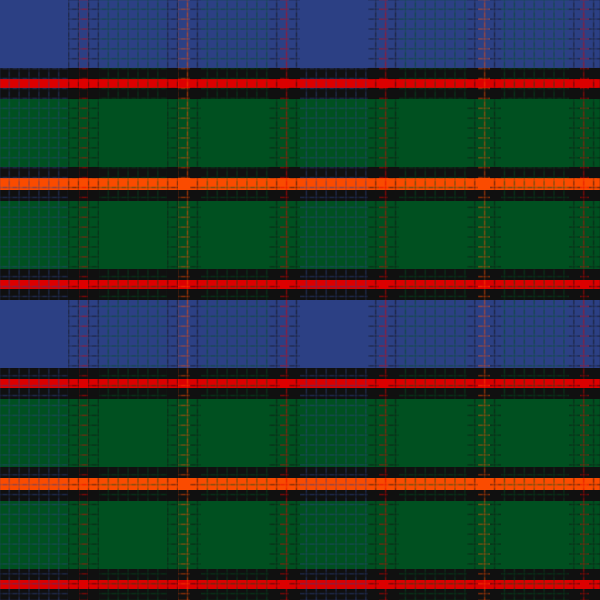 SkeneClan tartan · Register ref. 3802
This is the sett published by W. and A. Smith in 1850. The Register notes record a consensus that it was taken from a Wilson's of Bannockburn variant, and is not the original Skene sett.
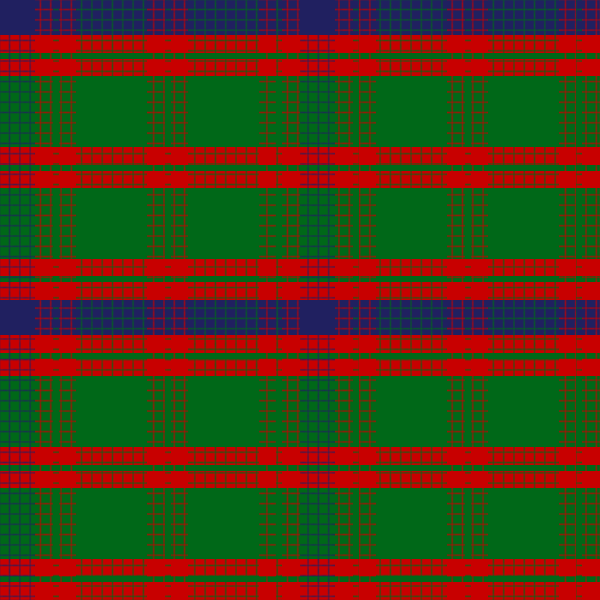 Skene #2Clan tartan · Register ref. 3803
Also from the Smiths' 1850 book, which said it was worn by the late Skene of Skene. The Smiths themselves doubted its antiquity, and the Register notes that its sources disagree about a blue line on the broad green.
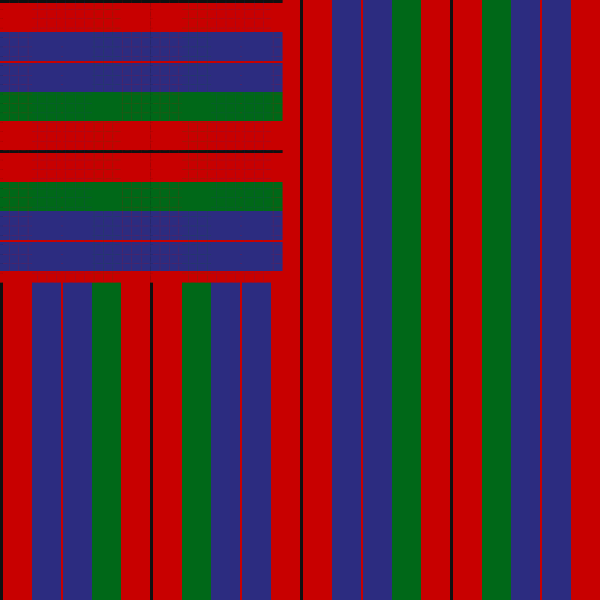 Skene of CromarClan tartan · Register ref. 3805
Registered in 2002. The Register notes say the thread count follows Coulson Bonnar's original rather than Dalgliesh's later one.
Get the kilt
When you order a kilt, ask for the tartan by its full name — for example “Skene” — and say which colourway you want. “Modern” is dark and strong, “ancient” is lighter, “weathered” is muted. The sett is the same in each.
We are choosing retailers we trust and will list them here soon.
Wear the colours
Our own Skene range is on its way: the name, the tartan and the motto on a heavyweight tee, a hoodie and a mug. About the shop.
Surnames
The clan name and its spellings
- Skene
- Skeen
- Skeene
- Skean
Names associated with Clan Skene
- Dyce
- Cariston
- Hallyard
- Halliard
- Rennie
- Carnie
- Norrie
- Diss
- Newtyle
- Dyce: Listed by Electric Scotland and COSCA; Dyce is also a place name in Aberdeenshire.
- Rennie: Listed by COSCA; the name is also found elsewhere in Scotland.
- Carnie: Listed by COSCA.
- Norrie: Listed by COSCA; Electric Scotland gives the form Norie.
- Newtyle: Listed by COSCA.
“Associated” means the name appears in published sept lists for this clan. It does not prove descent, and many names are linked to more than one clan. Where your family lived is often the better clue.
Questions people ask
What is the Skene tartan?
The Scottish Register of Tartans lists several Skene setts, including Skene, Skene #2 and Skene of Cromar. The first two come from the Smiths' 1850 book, and the Register notes that the first is probably not the original sett.
What is the Skene motto?
The motto is Virtutis regia merces, Latin for 'A palace the reward of bravery'.
Does Clan Skene have a chief?
Yes. The Lord Lyon recognised a Skene of Halyards as Chief of the Name and Arms, after the main line ended in 1827. COSCA lists the present chief.
Where does the name Skene come from?
It is said to come from the Gaelic sgian, meaning a dagger, through a tradition about a man who killed a wolf and was granted land in Aberdeenshire. That story is tradition, not documented fact.
Sources
- Skene (ref. 3802) — Scottish Register of Tartans
- Skene #2 (ref. 3803) — Scottish Register of Tartans
- Skene of Cromar (ref. 3805) — Scottish Register of Tartans
- Skene — COSCA - Council of Scottish Clans & Associations
- Skene (The Scottish Nation) — Electric Scotland
- Clan Skene — Electric Scotland
- Skene — Travel Scotland (scotland.org.uk)
Clan histories are contested and sources disagree. If you can correct something here with a source, write to hello@tartanflag.com. Last updated 31 October 2026.