Clan Sutherland
One of the oldest earldoms in Scotland, Clan Sutherland traces its roots to a Flemish-descended dynasty that ruled the far-northern county bearing its name from Dunrobin Castle for more than seven centuries.
History
Clan Sutherland traces its descent from Freskin, a Flemish-born nobleman settled in Scotland under King David I, who granted him lands including Duffus in Moray. Freskin's grandson, Hugh de Moravia, Lord of Duffus, gained a footing in the country of Sutherland in the far north, and Hugh's son William was made Earl of Sutherland around 1230, one of the oldest earldoms recorded in the Scottish peerage. The name Sutherland is itself a small puzzle: it is a relic of the Norse era, meaning roughly 'south land', because the county lay immediately south of the Norse-held earldom of Orkney and Caithness, even though it sits in the far north of the Scottish mainland.
For their first generations the earls used the surname de Moravia, 'of Moray', rather than Sutherland, and the family only settled consistently on Sutherland as its own name from around the time of Robert, sixth Earl, who died in 1427. The old Gaelic name for this stretch of country, Cataibh, means the land of the cat, and it survives both in the clan's crest, a wildcat rearing as if to spring, and in Morair Chat, the Gaelic style still used for the chief.
The earls' northern neighbours were often rivals rather than friends. A long rivalry with Clan Mackay, centred on the boundary between Sutherland proper and Mackay-held Strathnaver, is said to have run from the 1370s to a last pitched battle at Garbharry in 1555, and the Sutherlands also clashed with Clan Gunn, including at Leckmelm in 1586. How faithfully these old feuds have come down to us, against how much has been shaped by later retelling, is hard to weigh with confidence, but a contested northern frontier is well attested across the period.
The direct male line failed in 1514, when John, ninth Earl, died without a son and was succeeded by his sister Elizabeth. She married Adam Gordon, a son of the second Earl of Huntly and chief of Clan Gordon, and their descendants held the earldom as Gordons for two centuries, until John Gordon, sixteenth Earl, resumed the Sutherland name and arms and was recognised as such by the Lord Lyon in 1719.
The clan's most difficult chapter belongs to the early nineteenth century. Elizabeth, who had inherited the earldom as a one-year-old in 1766, kept personal control of the vast Sutherland estate even after marrying George Granville Leveson-Gower, created first Duke of Sutherland in 1833. Between roughly 1811 and 1821, thousands of tenant families were removed from inland straths such as Strathnaver to make way for large-scale sheep farming, in what became one of the most notorious episodes of the Highland Clearances; the estate's factor, Patrick Sellar, was tried in 1816 on charges including culpable homicide arising from the evictions and was acquitted. The episode is remembered very differently depending on who is telling it: estate correspondence of the day described it as agricultural 'improvement', while for the families cleared from their homes it meant the loss of land and community, and it remains one of the most bitterly contested chapters in Highland history.
The earldom passed through a female line again in the twentieth century. Elizabeth, 24th Countess of Sutherland, held the title until her death in December 2019, when it passed to her son, Alistair Sutherland, who is the present Earl of Sutherland and chief of the clan.
Clan Sutherland tartans
Names and reference numbers follow the Scottish Register of Tartans. Mills sell most setts in modern, ancient and weathered colourways. The pattern is the same; only the shades change.
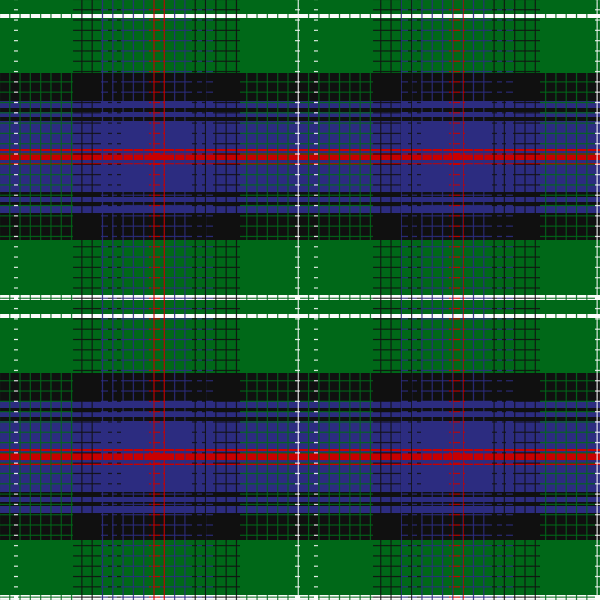 SutherlandClan tartan · Register ref. 4041
This is the sett recorded for the name in the Vestiarium Scoticum of 1829. The tartan historian Jamie Scarlett observed that its underlying structure is close to that of the Black Watch tartan, with red and white lines laid over it to mark it out as distinctly Sutherland.
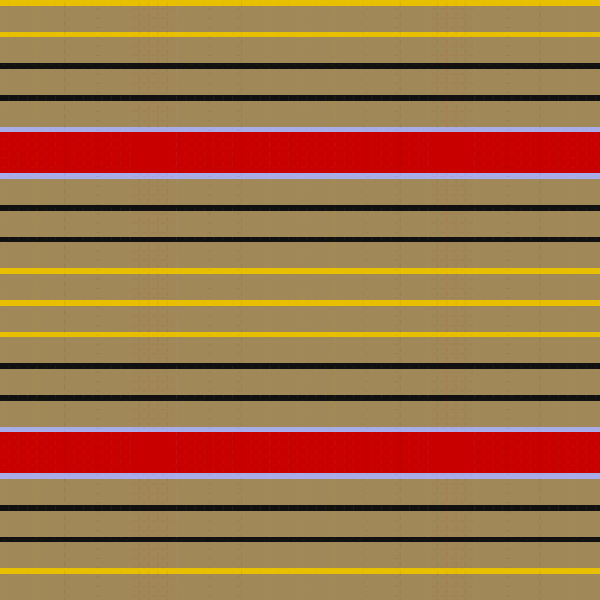 Sutherland of DuffusOther sett · Register ref. 5355
The earliest of the Sutherland tartans on record, this sett survives through a portrait of Kenneth, 3rd Lord Duffus, whose family was a cadet branch of the Sutherland earls, and may have been worn before the mid-eighteenth-century ban on Highland dress.
Get the kilt
When you order a kilt, ask for the tartan by its full name — for example “Sutherland” — and say which colourway you want. “Modern” is dark and strong, “ancient” is lighter, “weathered” is muted. The sett is the same in each.
We are choosing retailers we trust and will list them here soon.
Wear the colours
Our own Sutherland range is on its way: the name, the tartan and the motto on a heavyweight tee, a hoodie and a mug. About the shop.
Lands and seats
- Dunrobin Castle. The clan seat sits above the shore at Golspie, near the mouth of the Dornoch Firth. Part of the building goes back to the twelve-hundreds, though a Victorian rebuild under the architect Charles Barry, finished in 1845, is what gives the castle its turreted, storybook silhouette today.
Surnames
The clan name and its spellings
- Sutherland
- de Moravia
- Mowatt
Names associated with Clan Sutherland
- Gordon
- Murray
- Clyne
- Duffus
- Mowat
- Cheyne
- Federith
- Gray
- Oliphant
- Keith
- Norman
- O'May
- Gordon: The earldom passed to the Gordons of Huntly by marriage in 1514 and was held by Gordon earls until 1719, when the Sutherland name and arms were resumed.
- Murray: A branch of the Murrays may have been treated as a Sutherland sept by the early seventeenth century, though the Murrays are themselves a separate clan.
- Duffus: The Sutherlands of Duffus were a cadet branch of the earls, remembered in a separate tartan first recorded in the early eighteenth century.
- Cheyne: Clan Sutherland Society material notes this name cannot formally be claimed as a Sutherland sept under Scots law, though people bearing it may choose an association with the clan.
- Gray: Gray is itself the name of a separate clan; the historical link to Sutherland is loose rather than a formal sept relationship.
- Oliphant: Oliphant is itself the name of a separate clan with its own chief; the historical link to Sutherland is loose rather than a formal sept relationship.
- Keith: Only one branch of the Keiths is linked to Sutherland; Keith is itself a separate clan with its own chief.
“Associated” means the name appears in published sept lists for this clan. It does not prove descent, and many names are linked to more than one clan. Where your family lived is often the better clue.
Questions people ask
What tartan does Clan Sutherland wear?
Two Sutherland tartans are recorded on the Scottish Register of Tartans. The main Sutherland tartan is drawn from the 1829 Vestiarium Scoticum, while the older Sutherland of Duffus sett, on record from 1715, is linked to a cadet branch of the earls and may pre-date the 1746 ban on Highland dress.
What does the Sutherland motto mean?
The Sutherland motto is 'Sans Peur', French for 'Without fear'. It appears alongside the clan crest, a wildcat rearing up as if to spring.
Who is the chief of Clan Sutherland?
The chiefship is attached to the earldom of Sutherland. The present chief is Alistair Sutherland, 25th Earl of Sutherland, who succeeded his mother, the 24th Countess, on her death in December 2019.
What surnames are associated with Clan Sutherland?
Names such as Murray, Mowat, Clyne, Duffus, Gordon and Cheyne have historical associations with Clan Sutherland, though several of these, including Gray, Oliphant and Keith, are themselves separate clans and the link is one of association rather than belonging.
Sources
- Sutherland — Council of Scottish Clans & Associations (COSCA)
- History — Clan Sutherland Society
- Septs — Clan Sutherland Society
- Our Clan Chief — Clan Sutherland Society of North America (CSSNA)
- Our History — Clan Sutherland Society of North America (CSSNA)
- Our Symbols — Clan Sutherland Society of North America (CSSNA)
- Our Clan Seat — Clan Sutherland Society of North America (CSSNA)
- Our Septs and Associated Families — Clan Sutherland Society of North America (CSSNA)
- Elizabeth Sutherland, Duchess of Sutherland: Biography — Undiscovered Scotland
- Sutherland, ref. 4041 — The Scottish Register of Tartans, National Records of Scotland
- Sutherland of Duffus, ref. 5355 — The Scottish Register of Tartans, National Records of Scotland
Clan histories are contested and sources disagree. If you can correct something here with a source, write to hello@tartanflag.com. Last updated 22 September 2026.