Clan Wallace
A Lowland family from Ayrshire and Renfrewshire, first recorded in the twelfth century. Its most famous son is Sir William Wallace, Guardian of Scotland.
History
The name Wallace comes from the Old French 'waleis', meaning a Welshman. In Scotland it probably described a Briton of the old kingdom of Strathclyde rather than someone from Wales itself. Another view is that the family came north from the Welsh border in the following of the Stewarts. The sources do not settle the question.
The Scottish record of the family opens with Richard Walensis in the 1160s, when his name appears among the witnesses to a charter. He was a tenant of Walter fitz Alan, the High Steward, and his ground was in Kyle, in Ayrshire, not far from Kilmarnock. Riccarton, 'Richard's town', is said to be named after him. Two generations on, the inheritance was divided between the sons of his grandson Adam. Ayrshire stayed with the elder son. Malcolm, the younger, was given Elderslie and Auchinbothie across the county line in Renfrewshire. When Scots landholders swore homage to Edward I in 1296, the Ragman Roll listed an Adam de Waleys among them.
Tradition makes Sir William Wallace a son of Malcolm Wallace of Elderslie. Encyclopaedia Britannica says only that he was born around 1270, probably near Paisley. In 1297 he and Andrew Murray defeated an English army at Stirling Bridge. Wallace was made Guardian of Scotland. He was beaten at Falkirk the following year, and in 1305 he was captured and taken to London. He was executed there on 23 August 1305. He left no known line, and the later chiefs descend from his kinsmen, not from him.
The senior line became the Wallaces of Craigie, who are said to descend from William Wallace's uncle. They acquired Craigie in Ayrshire in 1371. Sir John Wallace of Craigie is credited with a leading part in the Scottish victory over an English force at the Sark. Accounts date the battle to 1448 or 1449. In 1669 Hugh Wallace of Craigie was made a Baronet of Nova Scotia. The baronetcy later passed through a granddaughter to the Dunlop family.
The chiefship came in time to the Wallaces of Cairnhill, who had inherited the Ayrshire estates of Busbie and Cloncaird. Captain Henry Wallace of Busbie and Cloncaird established his right to the chiefship in 1888. The thirty-fifth chief succeeded his brother at the start of the 1990s; sources give 1990 or 1991. He died in 2016. His son is the present chief, styled Wallace of that Ilk.
Unlike many clans, Wallace has no septs. That is the chief's own decision. The name itself has been spelled in many ways over eight centuries, and Wallis is the most common alternative today. The Clan Wallace Society, founded in Texas in 1966, welcomes all spellings of the name.
Clan Wallace tartans
Names and reference numbers follow the Scottish Register of Tartans. Mills sell most setts in modern, ancient and weathered colourways. The pattern is the same; only the shades change.
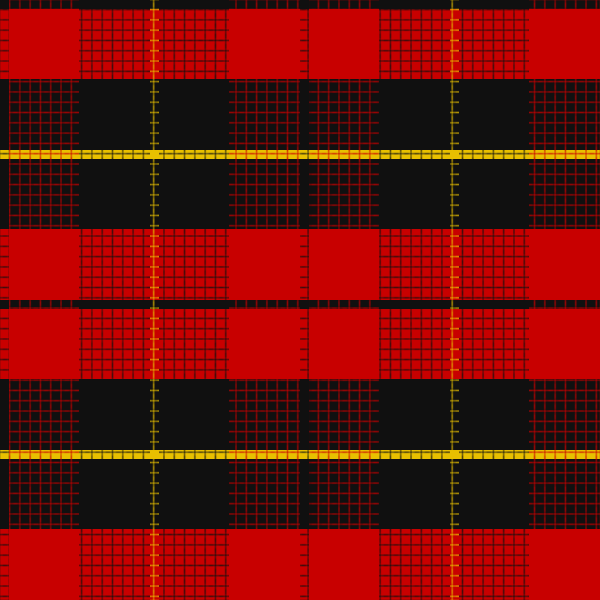 WallaceClan tartan · Register ref. 4482
The familiar red, black and yellow Wallace sett. The Register notes that its threadcount was recorded in the Lyon Court's Public Register of All Arms and Bearings in 1951.
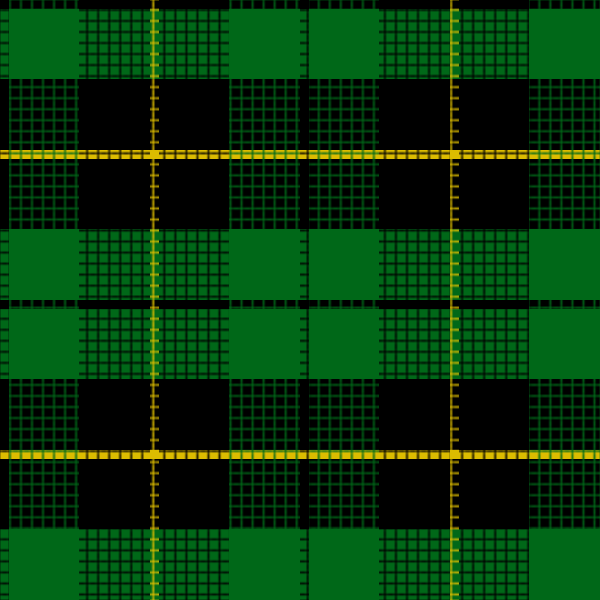 Wallace HuntingHunting tartan · Register ref. 4486
A green Wallace sett. The Register describes it as an existing pattern with green replacing the red, from a Lochcarron sample of around 1980.
 Wallace DressDress tartan · Register ref. 4485
A black and white sett. It is unnamed in the Highland Society of London collection, but samples in Inverness Museum and the MacGregor-Hastie collection are labelled Wallace Dress. The Register notes it is also known as Lendrum, or the Black and White MacFarlane.
Get the kilt
When you order a kilt, ask for the tartan by its full name — for example “Wallace” — and say which colourway you want. “Modern” is dark and strong, “ancient” is lighter, “weathered” is muted. The sett is the same in each.
We are choosing retailers we trust and will list them here soon.
Wear the colours
Our own Wallace range is on its way: the name, the tartan and the motto on a heavyweight tee, a hoodie and a mug. About the shop.
Lands and seats
- Riccarton. The family's first Ayrshire holding near Kilmarnock, said to be named after Richard Wallace.
- Craigie Castle. Ayrshire castle held by the Wallaces of Craigie from 1371.
- Elderslie. Renfrewshire lands of the younger branch from which, by tradition, Sir William Wallace came.
Surnames
The clan name and its spellings
- Wallace
- Wallis
- Wallice
- Walls
- Wallays
- Walleis
- Wallys
- Walys
- Walace
- Waleis
- Walensis
“Associated” means the name appears in published sept lists for this clan. It does not prove descent, and many names are linked to more than one clan. Where your family lived is often the better clue.
Questions people ask
What is the Wallace tartan?
The main Wallace tartan is a simple red and black check with a yellow line, reference 4482 in the Scottish Register of Tartans. There are also green hunting and black and white dress versions.
What is the Clan Wallace motto?
The motto is 'Pro libertate', Latin for 'For liberty'. The crest is an armoured arm holding a sword.
Does Clan Wallace have septs?
No. The chief has decided that the clan has no sept families, only Wallace. The name does have many historic spellings, of which Wallis is the most common.
Where do the Wallaces come from?
The family is first recorded in Ayrshire in the twelfth century, around Riccarton near Kilmarnock. A younger branch held Elderslie in Renfrewshire.
Sources
- Members (list of chiefs) — Standing Council of Scottish Chiefs
- Clan Wallace History — Clan Wallace Society
- Wallace — scotland.org.uk
- Clan Wallace — Electric Scotland
- Wallace clan crest — Scots Connection
- William Wallace — Encyclopaedia Britannica
- Clan Wallace (supplementary check) — Wikipedia
- Wallace – tartan details — The Scottish Register of Tartans
- Wallace Hunting – tartan details — The Scottish Register of Tartans
- Wallace Dress – tartan details — The Scottish Register of Tartans
Clan histories are contested and sources disagree. If you can correct something here with a source, write to hello@tartanflag.com. Last updated 17 September 2026.